 30-Sep-2026
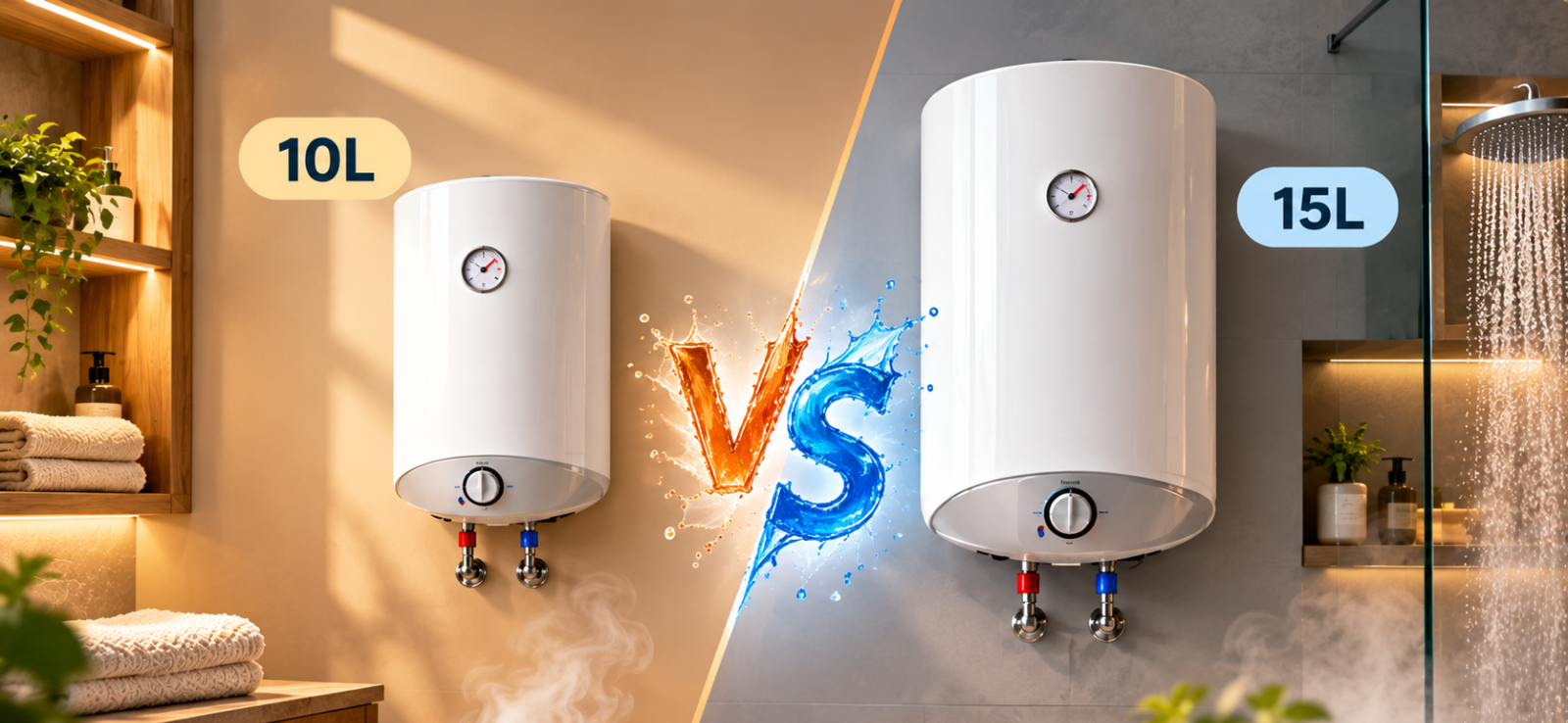
A storage geyser heats water well above bathing temperature. You then mix it with cold water at the tap. As a result, a 10 litre tank delivers noticeably more warm water than its label suggests. Roughly speaking, one full tank gives about double its volume once mixed to a comfortable temperature.
That means a 10 litre unit covers one bucket-style bath or two quick showers. A 15 litre unit covers three quick showers or two longer ones. However, these figures change with the season, because colder inlet water needs more heat.
Match the size to the number of people who use hot water in the same hour.
A larger tank is not always better. It takes longer to heat and costs more to keep hot, so an oversized unit wastes power in a small household.
Recovery time is how long the tank takes to heat again after you use it. A 15 litre geyser typically needs a little longer than a 10 litre unit, because it holds more water for the same heating element. Most household storage geysers draw around 1.5 to 2 kilowatts.
Check the label for the star rating as well. The Bureau of Energy Efficiency lists stationary storage type electric water heaters among its mandatory labelled appliances. A higher star rating means lower standing loss, which is the heat the tank loses while it waits.
A full 15 litre geyser weighs more than 20 kilograms, so the wall must be solid brick or concrete. Thin partition walls are unsuitable for it. A 10 litre unit is lighter and easier to fix in a small bathroom.
Water pressure matters on upper floors. If water arrives from an overhead tank without a pump, ask for a model suited to low pressure. Our guide on instant vs storage geyser explains the other main choice.
A couple in a one-bedroom flat in Noida usually manages with 10 litres, because the two showers happen at different times. A family of four in a Delhi builder floor with a school run suits 15 litres. Two roommates sharing a Mohali PG bathroom do well with 10 to 15 litres, depending on how closely their showers overlap.
You can compare current options for geysers on rent in Delhi, Noida and Mohali.
Take a family of four in a flat with one bathroom. Two adults and two school-age children bathe between 6:30 and 8:00 in the morning. A shower typically uses somewhere around 20 to 25 litres of mixed water, so the household needs roughly 90 litres of mixed water in ninety minutes.
A full 15 litre tank, mixed down at the tap, supplies about 30 litres of usable water per cycle. That covers one or two showers before the tank needs time to recover. Therefore, the family must stagger baths by twenty minutes or so, which is workable on a school morning only if everyone cooperates.
A 25 litre unit removes most of that pressure, because three showers fit in one cycle. However, it needs a stronger wall and a longer heating time before the first bath.
The first mistake is sizing for the biggest day instead of the typical day. A house that hosts guests twice a year does not need a tank sized for ten people. Instead, size for the daily routine and accept a short wait on the busy days.
The second mistake is ignoring the wall. A full tank weighs far more than the empty unit, and a thin partition wall cannot carry it safely. Check the wall before you decide on the capacity, because a smaller tank on a solid wall is safer than a larger one on a weak wall.
The third mistake is forgetting the bathroom layout. A tall vertical unit may not fit under a low ceiling or beside a window, whereas a horizontal model may.
Cold inlet water changes the answer. In January, tap water can be much colder than in October, so the same tank heats more slowly and gives less mixed water. As a result, a size that felt generous in autumn may feel tight in midwinter.
A thermostat setting near 55 to 60°C balances comfort and standing loss. Setting it higher makes the water hotter, but it also increases scale and heat loss. A timer helps too, since the tank can heat before the first bath and then switch off.
Ask for the exact capacity printed on the label, because marketing names do not always match the real volume. Also ask whether the unit suits low-pressure supply if your building uses an overhead tank. Request the star rating, and check that the heating element is fitted with an automatic cut-off.
Finally, ask who will fix the unit to the wall and who checks the socket. A tank that is heavy, full and badly fixed is a hazard, so the fitting deserves as much attention as the size.
Households in Gurugram and Faridabad often live in apartments with overhead tanks, so pressure and wall type matter as much as capacity. In Ghaziabad, shared bathrooms in rented rooms usually suit a 10 litre unit for each room. Tenants in Chandigarh face long, cold winter mornings, which favour the larger size for a family.
Usually not. Four people showering within an hour exceed what one 10 litre tank can supply, even with mixing. A 15 litre geyser is the safer choice, and 25 litres suits households with long bath routines or two children bathing together.
It uses more energy to heat the larger volume, and it loses more heat while standing. However, the difference is small when both are used daily. An oversized geyser in a small household wastes power, so match the size to real use.
For one or two people, 10 litres is usually enough and heats faster. Three roommates sharing a bathroom need 15 litres. In every case, check that the wall and the socket can safely carry the unit, and ask whether the tank has a valid star label before you accept delivery.
Yes. A 15 litre tank holds more water for the same heating element, so it takes longer to reach the set temperature than a 10 litre tank. The wait matters most on cold mornings. Using a timer solves the problem, since the tank heats before you wake.
Technically yes, if the plumbing is arranged for it, but the distance between outlets matters. Long pipes lose heat and waste water while you wait for it to warm. Many households therefore use a storage unit in the bathroom and a small separate unit above the kitchen sink.
For a 10 litre vs 15 litre geyser decision, count the people who bathe in the same hour. Ten litres serves one or two people, and fifteen litres serves three or four. Check the wall strength, the water pressure on your floor and the star label before you commit.
If you are unsure whether the tank type is right for your home, the next step is the guide on geyser on rent, which explains how short-term plans work for tenants.
 Welcome to Rentit4me

