 26-Nov-2026
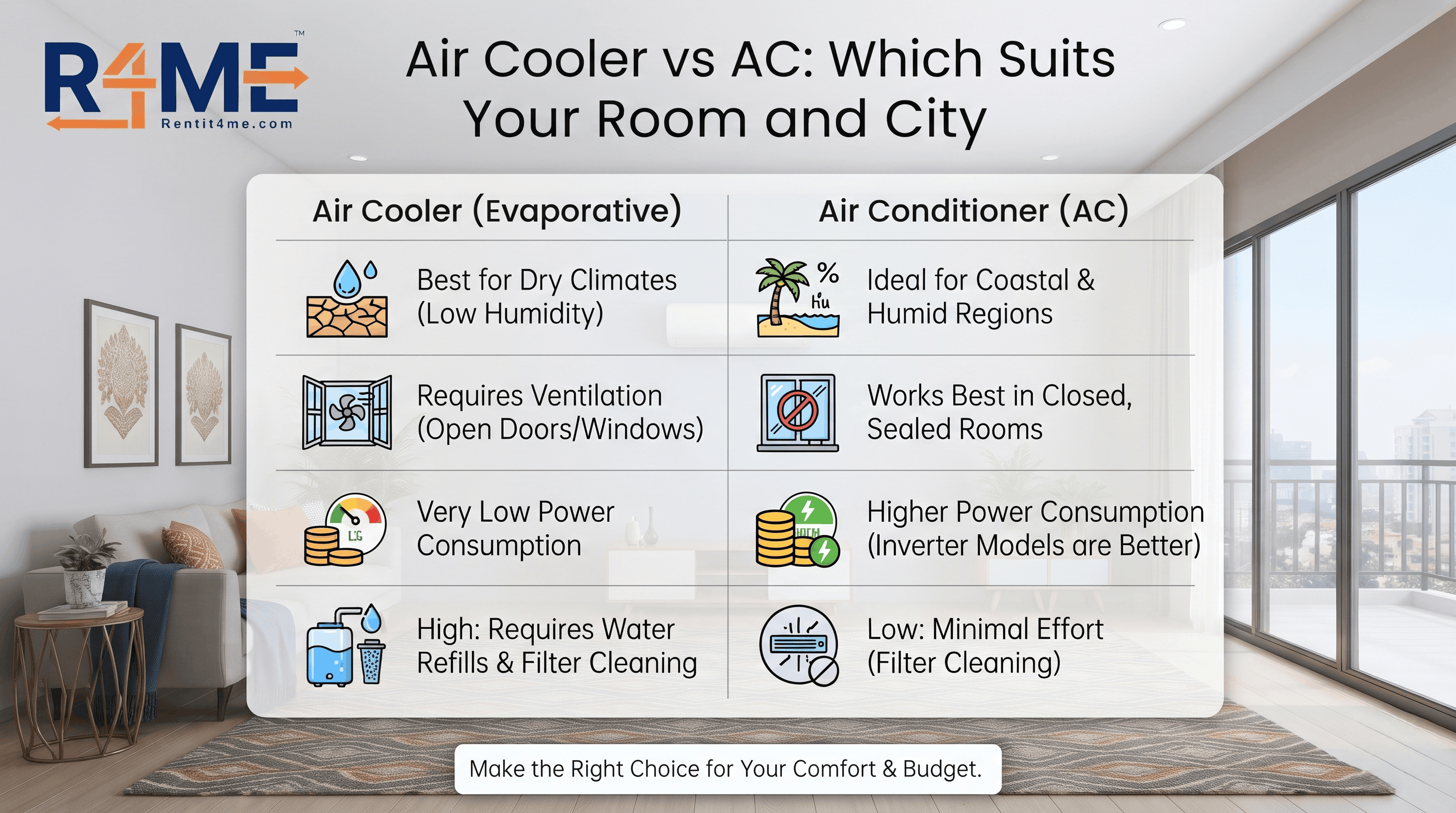
Air cooler vs AC comes down to climate and room: coolers work well in hot, dry weather with open windows, while an air conditioner cools and dehumidifies in humid or sealed rooms. Cost, power draw and comfort differ sharply between them. This guide compares both for Indian cities so you can match the appliance to your home.
An air cooler pulls air through a wet pad, and the evaporating water lowers the air temperature. It needs fresh air to keep flowing, so a window or door must stay slightly open. It also adds moisture to the room.
An air conditioner works differently. It removes heat and moisture from the air in a closed room and sends the heat outside. As a result, it can lower the temperature and the humidity together, even when the windows are shut.
Humidity decides most of the comparison. In dry heat, evaporation is fast, so a cooler can drop the air temperature noticeably. In humid air, evaporation slows, and the cooler adds more moisture, which feels sticky.
The India Meteorological Department publishes regional weather and climate information that shows how humid your city is in each season. Coastal cities stay humid for much of the year, while inland cities have a dry spell before the monsoon.
A cooler uses far less electricity than an AC, because it runs a fan and a small pump instead of a compressor. It is also cheaper to buy. However, it needs regular water refills and pad cleaning, and it works poorly in a closed room.
An AC costs more to buy and run, but it gives steady comfort at a chosen temperature. Setting it near 24°C is widely recommended by efficiency bodies such as the Bureau of Energy Efficiency, since every degree lower raises power use.
Choose a cooler for a large, well-ventilated room in a dry city, or for a balcony, shop or workshop where an AC cannot hold the cold. Choose an AC for a bedroom you keep closed, for humid weather, or for people who need good sleep in the heat. For many homes, a cooler in the living area and an AC in one bedroom is a sensible mix.
If you only need cooling for a few months, you can also compare short-term plans in the guide to AC and air cooler on rent.
Consider a two-bedroom flat in Pune with a living room of about 200 square feet and a bedroom of about 120 square feet. In April, the daytime air is hot and dry, and the living room has a balcony door that stays slightly open. A cooler placed near that door pulls in outside air, passes it over the wet pad and pushes it into the room.
The room feels noticeably cooler, and the family can run it all afternoon at low power.
The bedroom is different. It has one window facing a busy road, and the family keeps it shut at night to block noise and dust. A cooler would need an open window to work, so the room would be either noisy or stuffy. An AC suits this room better, because it cools and dries the air without any opening to the outside.
Practical details often decide the final choice. A cooler is a floor-standing box with a water tank, so it needs clear floor space near a window or door. Its fan is audible, and the sound can bother light sleepers.
The tank needs refilling every day or two in heavy use, and the pads need cleaning so that they do not smell or clog. Water left standing for several days can also attract mosquitoes, which is why many users drain the tank when they travel.
An AC takes up wall space instead of floor space. The indoor unit sits high on the wall, and the outdoor unit needs a bracket outside the building. Filters need cleaning every few weeks in dusty weather, and a technician should service the unit before the hot season. As a result, an AC asks for less daily effort than a cooler but more planning at the start.
You do not need instruments to judge your conditions. Check the weather on the day you plan to use the appliance. If the air feels dry and laundry dries within a few hours, a cooler is likely to help. If clothes stay damp and the air feels heavy, an AC is the safer choice. You can also ask a neighbour who already uses a cooler how it behaves in July.
Next, look at the room itself. Count the windows that can stay open safely at night, and note whether outside noise or dust makes that unrealistic. A room with no safe opening cannot use a cooler properly. Finally, think about who uses the room, because elderly relatives, infants and people with breathing problems may prefer the steady, filtered air of an AC.
Four mistakes come up often. Buyers place a cooler in a shut room and then wonder why it feels damp. They choose an AC far larger than the room needs, which raises running costs. They set the AC to its lowest temperature, which strains the unit and the electricity bill. They also ignore maintenance, so a clogged pad or filter weakens the cooling by the second month.
Mumbai and Thane stay humid through the year, so an AC is usually the more comfortable option there. Pune has hot, drier spells in April and May, when a cooler can help in a ventilated room. Bengaluru's summer is milder, so many homes need cooling only for a few weeks.
You can check what is listed for Mumbai, Thane, Pune and Bengaluru.
It can work in a dry climate if a window stays open, but the added moisture and noise bother some sleepers. In humid cities, a cooler makes a closed bedroom feel sticky. An AC is usually the more reliable choice for a bedroom that stays shut.
Not well. Humidity is high during the monsoon, so evaporation slows and the air feels damp rather than cool. A cooler can still move air as a fan, but the cooling effect drops sharply. An AC with a dry mode handles humid weather better.
A cooler uses much less electricity than an AC, because it has no compressor. However, comfort differs, so the saving only matters if the cooler actually keeps the room comfortable. Compare comfort and running cost together, not power draw alone.
It is possible but rarely useful. A cooler needs an open window, while an AC needs the room to stay closed, so one works against the other. If the AC is running, shut the room and switch the cooler off. Use the cooler in a different, ventilated area instead.
Yes, or at least an open door. A cooler works best when fresh air enters and warm, moist air leaves, so a closed room becomes humid quickly. Placing the cooler near a window, with a second opening on the far side, gives a cross-flow that keeps the air moving and the room more comfortable.
The air cooler vs AC choice depends on humidity, ventilation and how you use the room. Dry heat and open windows suit a cooler, and humid weather or a closed bedroom suits an AC. Test your own conditions before you commit, and consider a mix if your home has both kinds of room.
If you decide on an AC, the next question is size, and the guide to AC tonnage for room size explains how to pick a capacity that matches your room without overpaying.
 Welcome to Rentit4me

