 26-Nov-2026
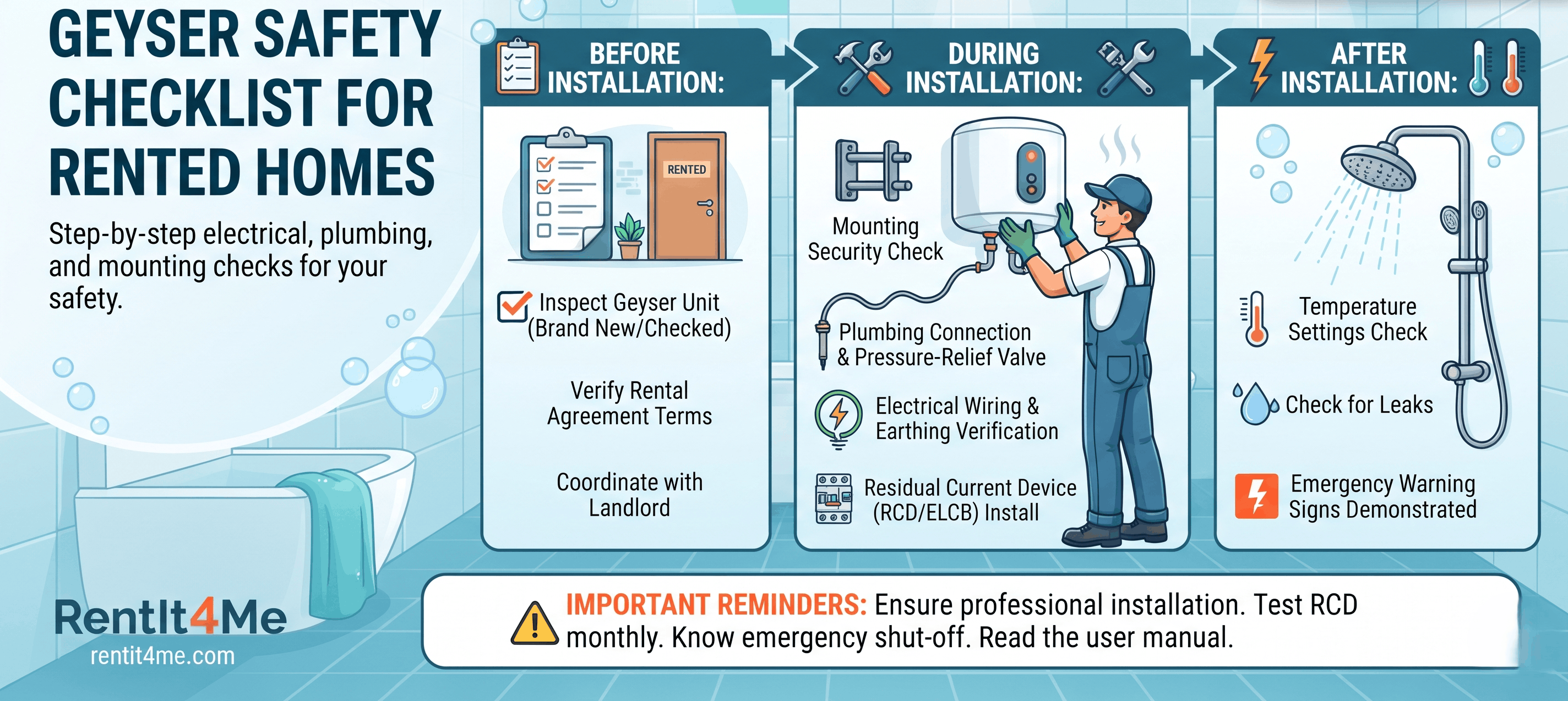
A geyser safety checklist should confirm an earthed socket with a rated circuit breaker, a solid wall, a clear pressure-relief valve, and a switch outside the wet area. Most geyser accidents come from installation faults, not from the appliance. This checklist covers what to check before, during and after installation in a rented flat, PG or hostel.
Start with the electrics. The geyser needs a dedicated socket of the right rating with its own circuit breaker, not a loose point shared with a hair dryer. Ask an electrician to confirm that the earth connection is real, because an unearthed geyser can make its body live during a fault.
Next, inspect the wall. A full 15 litre tank weighs over 20 kilograms, so the wall must be solid brick or concrete. Use the manufacturer's bracket and proper fixings. Place the unit at least 60 centimetres from the shower head. Finally, ask the landlord's permission for drilling.
Use proper connection pipes and avoid old, cracked or kinked ones. Fit the pressure-relief valve and the non-return valve correctly. Never block the valve outlet or run it into a closed pipe, because trapped steam can burst the tank.
Fill the tank completely before you switch on, since running a storage geyser empty damages the element. Check every joint for leaks with the tank full.
Daily habits matter as much as installation. Use this short list:
Keep the switch outside the bathroom.
Switch the geyser off once the water is hot.
Set the thermostat near 55 to 60°C.
Never touch the geyser or its switch with wet hands.
Keep the area around the unit dry and clear.
A timer helps, because the geyser heats before you wake and then switches off.
Switch off at the main and report the fault if you notice any of these:
Tingling or mild shocks from taps or the geyser body.
The breaker tripping whenever the geyser is on.
Water leaking from the body, or constant dripping from the valve.
A burning smell, sparks or a hot plug.
Banging or loud hissing from the tank.
Some dripping from the relief valve while the water heats is normal. Constant dripping is not.
The Bureau of Indian Standards lists safety requirements for storage heaters under IS 302-2-21 and for instantaneous heaters under IS 302-2-35 in its overview of household appliance standards. Check for the standard mark and a legible rating label before accepting any unit. Hard water also affects safety, so read about the hard water geyser problem.
In a PG, give each room or bathroom its own socket and avoid daisy-chained extension leads. In a new flat in Noida, confirm the bathroom wiring is permanent before fitting a geyser. Hostels in Faridabad and Mohali should check the building's total load when several geysers run together.
Water and electricity must stay apart, so the position of the geyser matters. Keep the unit away from the direct spray of the shower, and mount it high enough that splashes do not reach the body. Place the switch outside the bathroom, or use a pull cord that keeps the contact area dry.
Next, check the clearance. The unit needs space around it, and the pipes must not strain under the weight of the tank. Also avoid fixing the unit above the bath or the head of the shower, where steam and drips collect.
Ask an electrician to confirm four things in writing. The wire should be thick enough for the unit's rating. The socket should be rated for the load and should hold the plug firmly. The earth should be real and tested. A breaker, ideally with a residual current device, should protect the circuit.
A residual current device cuts the power when it senses leakage, which can prevent a serious shock. However, it does not replace proper earthing, so both should be present.
Households with children need extra care. Keep the thermostat at a moderate setting so that water does not scald. Teach children never to touch the unit or its switch with wet hands. In homes with older people, a lower temperature setting and a visible switch reduce the risk of burns and confusion.
In a shared bathroom, agree who switches the unit off after use. A simple note near the switch avoids a geyser being left on for hours.
Run a short inspection at the start of each winter. First, look for rust, stains or white deposits around the joints. Next, check the cable and plug for discolouration or cracks. Then test the pressure-relief valve for free movement. Finally, test the breaker and the residual current device with the test button.
Write the date in a notebook or in your phone. As a result, you can see at a glance when the last check took place.
If you feel a tingle, see sparks, smell burning or notice water leaking near the electrics, switch off at the main supply at once. Do not touch the unit with wet hands or while standing in water. Call an electrician and report the fault to the provider or the landlord.
If steam or hot water escapes from the valve in large quantities, keep away, switch off the supply and ask for urgent help.
Refuse a fitter who offers to skip the earth wire, to use a loose extension lead or to block the valve outlet. Refuse an installation in which the pipe is joined with tape and string. These shortcuts save a few minutes and can lead to a serious accident.
A careful fitter explains each step and does not mind being asked. If someone resists your questions, ask for another fitter.
Yes. Earthing carries fault current safely to the ground and keeps the geyser's body from becoming live. Ask an electrician to test the earth connection before the first use, and do not rely on a socket that only looks correct.
Usually the tenant or the landlord arranges the point through an electrician, not the geyser provider. Confirm this before delivery day, because a missing or unsafe point delays installation and can make the fitting unsafe. Ask the electrician to check the socket rating, the breaker and the earth wire together.
Some dripping from the pressure-relief valve while the water heats is normal, because expanding water escapes. Constant dripping after the geyser has heated, or a leak from the tank body, is not normal. Switch off at the main and report it, because a blocked valve can be dangerous.
It is better not to. Switching the unit off once the water is hot saves energy and reduces risk, particularly if nobody is home. A timer can heat the tank before your bath, and then switch it off automatically, which is more convenient than leaving the unit on.
It monitors the current flowing in and out of the circuit and cuts the power quickly if some of it leaks, for example through a person. It adds a layer of protection, but it works alongside proper earthing and a rated breaker, not in place of them.
A geyser safety checklist works best when you run it twice: once before the first use and again at the start of each winter. Confirm the earth, the breaker, the valve and the wall, and keep the switch outside the bathroom. Repeat the check whenever the geyser is moved, serviced or fitted in a new room.
Because tenants share responsibility with landlords, put the checks in writing, with dates, so that both sides know who confirmed what. If you are still choosing a unit, the guide to instant vs storage geyser explains which design suits your wiring.
 Welcome to Rentit4me

