 26-Nov-2026
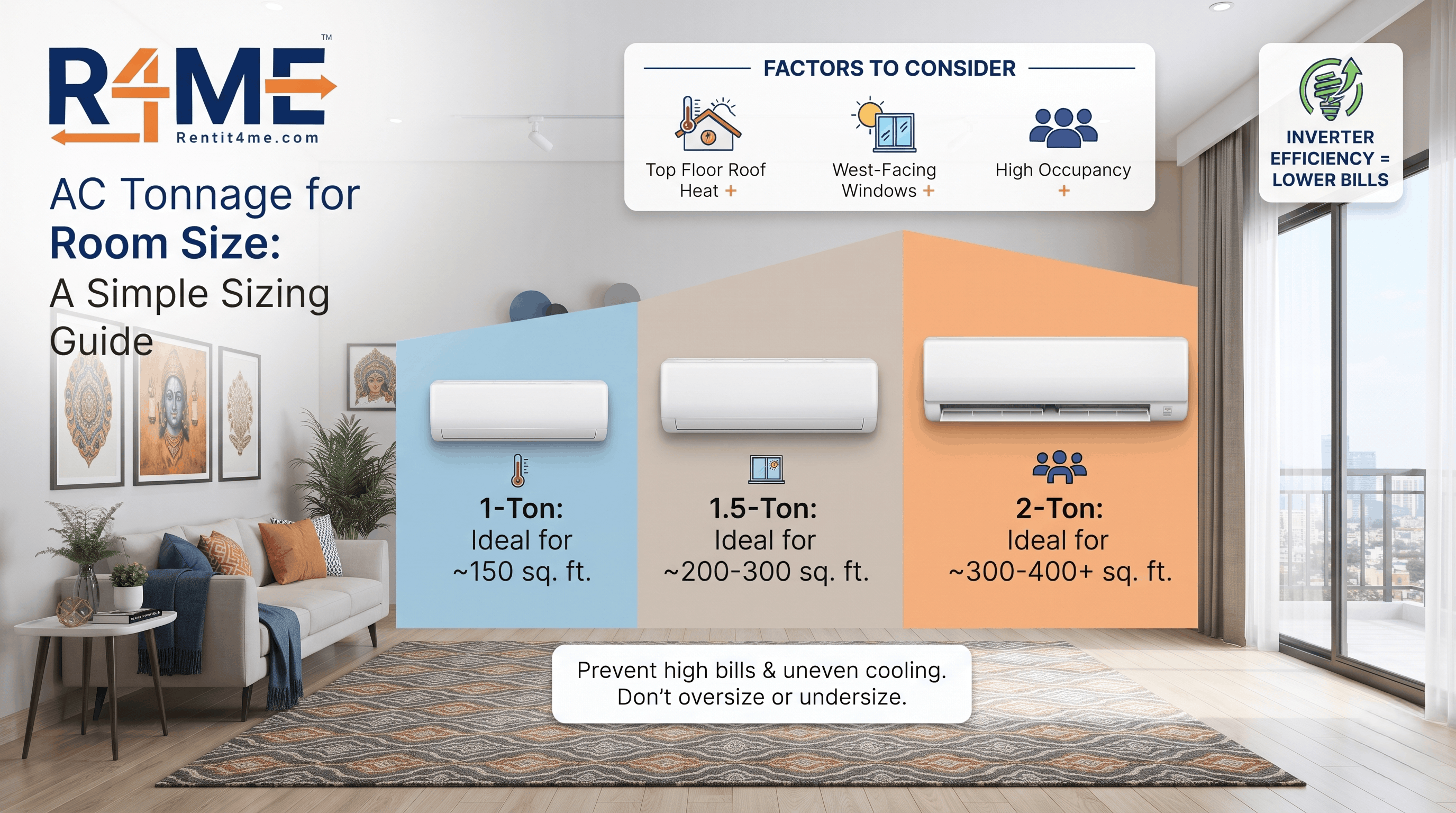
The right AC tonnage for room size depends on floor area, but sun exposure, ceiling height and the number of people can change the answer. As a rough guide, one ton suits small rooms, 1.5 tons suits medium bedrooms, and two tons suits large halls. This guide explains how to size an AC without overpaying.
One ton of cooling equals the heat removal of 12,000 BTU per hour, so a higher tonnage removes heat faster. The term has nothing to do with the weight of the machine.
Capacity must match the heat load of the room, because an undersized AC runs constantly and never reaches the set temperature. An oversized unit cools quickly and then switches off, which can leave the air humid and the room uneven.
Measure the length and width of the room in feet and multiply them to get the floor area. For an L-shaped room, split it into two rectangles and add them together.
Note the ceiling height too, since most calculations assume a standard height of about ten feet, and a taller room holds more air to cool. If the room opens into a hall or kitchen without a door, include that space in your estimate, because the AC will try to cool it as well.
The figures below are indicative ranges commonly given by manufacturers, not a fixed standard. Treat them as a starting point.
For a method to estimate cooling load more carefully, the US Department of Energy explains the factors in its room air conditioner guide.
Several conditions push you to the next size up. A top-floor room under a sun-heated roof gains far more heat than a middle-floor room. A west-facing window adds afternoon heat. A high ceiling holds more air to cool.
People and equipment matter too, since each person adds heat and so do computers, ovens and lighting. Therefore, a home office with two screens may need more capacity than a bedroom of the same area.
Start with the floor area and match it to the range. Next, move up one size if the room is on the top floor, faces west or has a high ceiling. Move down only if the room is shaded, small and used by one person.
Do not oversize out of habit. A two-ton unit in a 110 square foot room costs more to run and cools the room unevenly. Compare options in the guide to renting an AC before you commit to a size.
The first example is a 100 square foot bedroom on a middle floor, shaded by a neighbouring building and used by one person. A one-ton unit fits comfortably, and a larger unit would only waste power.
The second example is a 140 square foot bedroom on the top floor with a west-facing window. The area alone points to 1.5 tons, and the heat from the roof and the afternoon sun confirms it. Curtains or a reflective film on the window reduce the load further.
The third example is a 220 square foot living room joined to a dining area, used by a family of five and a television. The area points to two tons, and the open layout and the number of people make the larger size sensible. If the space is much larger than 250 square feet, two smaller units may cool more evenly than one large unit.
Three mistakes are common. Buyers pick the largest size available, assuming that more power always cools better. Others choose by price alone and end up with a unit that cannot keep up in May. Some ignore the top-floor and window effects and size only by area. Therefore, work through area, exposure and occupants in that order, and compare your result with the cooling capacity stated in the unit's manual.
A larger AC draws more current, so capacity and wiring must match. A 1.5 ton unit and a two-ton unit may need different circuit breakers and wire gauges, and the manual states the rating. An electrician can confirm whether the existing socket and cable suit the unit you choose. In older rented flats, this check sometimes decides the size, because thin wiring cannot safely carry a larger load.
Usage changes the picture as well. A bedroom AC that runs only at night faces a lower load than a living-room unit that runs from noon to midnight. Likewise, a home office used through the afternoon peak needs more reserve capacity than a guest room used on weekends. If the room is used only a few weeks a year, a slightly smaller unit running steadily is usually enough.
An inverter AC adjusts compressor speed, so it avoids repeated switching and uses less power over time. The star label shows the unit's efficiency, and the Bureau of Energy Efficiency explains the scheme on its official website. A higher rating usually costs more upfront and less to run.
Flats in Mumbai and Thane are often compact but humid, so a right-sized 1 or 1.5 ton unit with a good dry mode works well. Top-floor flats in Pune may need the next size up. In Bengaluru, moderate temperatures often make 1 ton enough for a bedroom.
Usually yes, under normal conditions. A 150 square foot room falls in the typical 1.5 ton range. If the room is on the top floor, faces west or has many people, a two-ton unit may cope better. Check the exposure before you decide.
An oversized AC cools the room quickly and then switches off, so it does not run long enough to remove humidity. The air can feel clammy, temperatures can swing, and electricity use may rise. A correctly sized inverter unit usually gives steadier comfort.
Often yes, because the roof absorbs sun and passes heat into the room. Many buyers move up one size for a top-floor room, especially in hot cities. Insulation, reflective roof coating and shaded windows can reduce the need, so check these before you pay for a larger unit.
A single split AC cools the room it sits in, and it cools a connected room only partly. Air does not travel well through a closed door or around a corner. If you want to cool two rooms, use one unit per room, or choose a layout where the rooms share an open archway and fall within one capacity range.
A larger AC runs for more hours in peak heat, so efficiency matters more as the size rises. A higher star rating and an inverter compressor usually cut running cost over the season, although the unit costs more to buy. Compare the extra purchase cost against the hours you expect to run it before choosing.
For AC tonnage for room size, begin with floor area, then adjust for sun exposure, ceiling height and the number of people. One ton suits small rooms, 1.5 tons suits medium rooms, and two tons suits large ones under typical conditions, though a top-floor room may need the next size up.
If the flat is rented, fitting is the next issue to settle. The guide to AC installation in a rented flat covers permissions, wiring and wall work in detail.
 Welcome to Rentit4me

