 26-Nov-2026
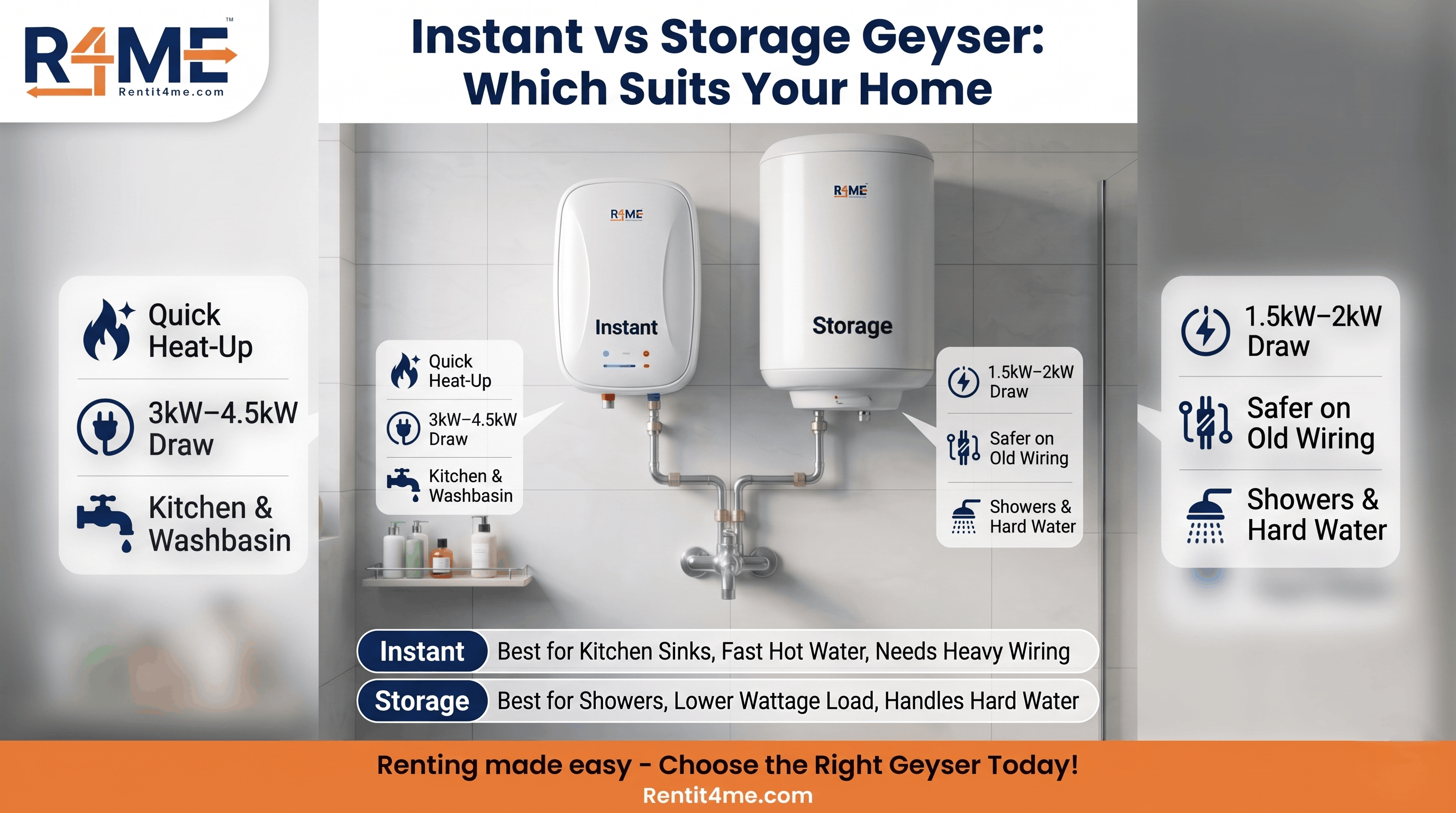
The instant vs storage geyser choice comes down to this: an instant unit heats water as it flows and draws more power, while a storage unit heats a tank and keeps it hot. Instant units suit a kitchen sink or a quick wash. Storage units suit showers and families. This guide compares power, wiring, space and cost.
An instant water heater passes cold water over a powerful element and delivers hot water within seconds. Capacity is small, usually one to three litres, and power draw is high, often around three kilowatts.
A storage water heater heats a tank of six to twenty-five litres and holds it at a set temperature. It draws less power at a time, typically 1.5 to 2 kilowatts, but needs time to heat the tank before first use.
Neither type is better in general. The better one is the one that matches your wiring and your routine.
Choose an instant unit when you need small amounts of hot water at short notice. A kitchen sink, a basin or a quick wash suits it. It also suits a bathroom with no wall space for a tank.
However, the high power draw is the main limit. Many older flats have thin wiring that overheats under a three-kilowatt load. Have an electrician confirm the line before you fit one.
Choose a storage unit for showers and for households where several people use hot water in the morning. The lower power draw is easier on old wiring, and the flow stays steady and comfortable. Sizing is covered in the guide to the 10 litre vs 15 litre geyser.
Water pressure matters too. On upper floors fed by an overhead tank, a standard unit may deliver a weak flow. Ask for a model suited to low pressure.
The Bureau of Indian Standards covers storage heaters under IS 302-2-21 and instantaneous heaters under IS 302-2-35, as listed in its safety standards overview. Look for the standard mark on either type.
In Ghaziabad towers, pressure and wiring decide the choice. In Noida new flats, wiring may be temporary, so storage units with lower draw are safer. In Indore, a compact instant unit above the kitchen sink is a common addition to a bathroom geyser.
Running cost depends on how often and how long you use hot water. An instant unit draws a large current for a short time, so it suits a few small uses a day. A storage unit draws a smaller current, but it heats a whole tank and then keeps it warm, so it loses some energy even when nobody is using it.
For a household that showers every morning, a storage unit with a good thermostat and insulation is usually economical. For someone who needs a litre or two of hot water a few times a day, an instant unit may use less in total, because it avoids standing loss.
Therefore, count your daily uses before you compare the two on cost.
Wiring is the most overlooked part of the decision. A three-kilowatt instant unit pulls roughly three times the current of a small electric kettle running for a long time. Old flats often have thin wires, shared circuits and loose sockets that overheat under this load.
First, ask an electrician to check the wire gauge and the breaker. Next, confirm that the socket is rated for the load and that it has a proper earth. As a result, you avoid warm plugs and tripping breakers, which are early signs of an overloaded line.
An instant unit has a small heating chamber that scales up quickly in hard water, and the flow can fall as scale builds up. A storage tank lets scale settle over a larger area, but the element and the anode still need servicing. In both cases, a periodic service by a technician keeps the unit efficient.
If your water is hard, ask about a glass-lined tank or a coated element for a storage unit. For an instant unit, plan to descale the chamber on a regular schedule.
Many homes combine the two types. A storage unit in the bathroom serves showers, and a small instant unit above the kitchen sink handles washing up. This arrangement keeps the heavy load on the bathroom circuit and the light load on the kitchen circuit, and it avoids long waits at the sink.
However, check that the two units are on separate circuits, since running both on one line can overload it. In a rented flat, also ask the landlord before adding a second unit.
People often buy an instant unit for a shower without checking the wiring, and then find that the flow is weak and the breaker trips. Others choose a large storage tank for one person and pay to heat water they never use. A third mistake is placing the switch inside the bathroom, where wet hands can touch it.
Each of these mistakes is easy to avoid with a short check before purchase or rental.
Tenants in Gurugram and Faridabad often live in apartments with variable wiring, so a storage unit with a lower draw is the safer starting point. Households in Chandigarh and Mohali face cold mornings that favour the storage design for showers.
For short, occasional use, yes, because it heats only the water you use. For daily showers, a storage geyser with a thermostat is usually more economical. The instant unit's high power draw also needs strong wiring, which can add cost.
It works at low flow, but the high power draw and weaker flow make it a compromise. A storage geyser gives a steadier shower. If you choose an instant unit for a shower, confirm that the wiring is rated for the load.
Typically 15 to 40 minutes, depending on capacity and the cold water temperature. Winter inlet water is colder, so heating takes longer. A timer helps, because the geyser can heat the tank before you wake up and then switch itself off once the water is ready.
Often yes. A high-power instant unit needs a line that can carry the current safely, with a rated socket, a breaker and a working earth. Ask an electrician to check before fitting, especially in an older building, because thin wires can overheat under a heavy, continuous load.
Lifespan depends more on water quality, servicing and usage than on the type. Hard water shortens the life of both, since scale builds on the element. A storage unit with a glass-lined tank and a replaced anode can last many winters, while an instant unit lasts when the chamber is descaled regularly.
In the instant vs storage geyser choice, instant suits small, occasional use and storage suits showers and families. Check your wiring first, because an instant unit's three-kilowatt draw is the main risk in older flats with thin cables.
Then check water pressure and wall strength for a storage tank, since a heavy full tank on a weak wall is the main risk there. If you plan a short stay, the guide on geyser on rent explains how tenants avoid buying either type.
 Welcome to Rentit4me

