 23-Nov-2026
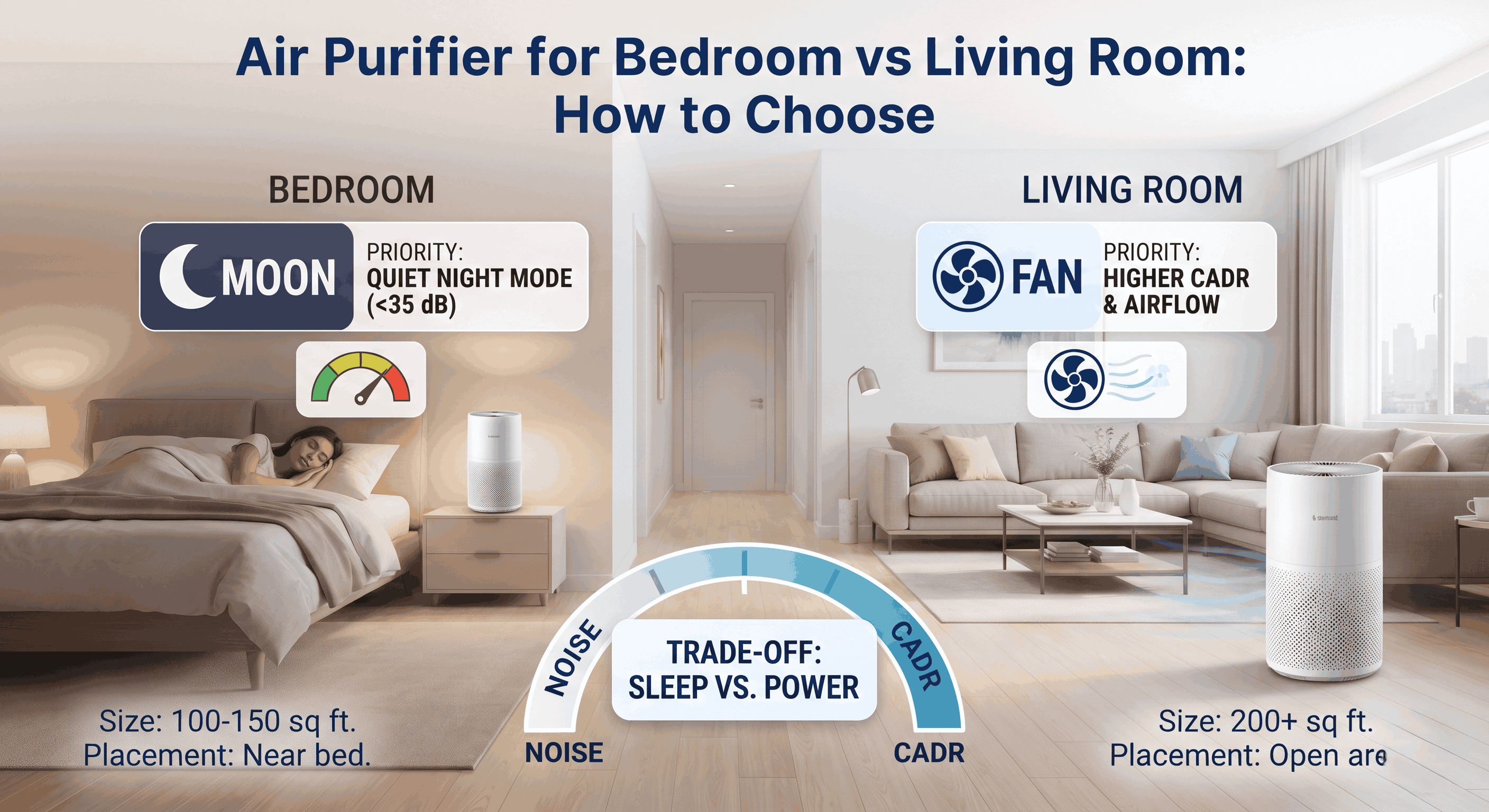
For a bedroom, choose an air purifier that stays quiet at night and has enough CADR for a smaller room. For a living room, choose a higher CADR, because the space is larger and more open. The two rooms swap priorities: noise comes first in the bedroom, and airflow comes first in the living room.
Image: side-by-side floor plans of a bedroom and a living room with purifier positions. Alt text: "air purifier placement in a bedroom compared with a living room".
| Factor | Bedroom | Living room |
Typical priority | Low noise and night mode | Higher CADR and coverage |
Room size | Often 100 to 150 sq ft | Often 200 sq ft or more |
Usage | Overnight | Daytime and evening |
Placement | A few feet from the bed | Open area, away from corners |
The room sizes are typical examples, so measure your own. Use the CADR formula with floor area, ceiling height and ACH to get the number.
Sleep is sensitive to noise. Guides suggest keeping a bedroom purifier at about 30 to 35 dB at night, and another guide says under 30 dB. These decibel values are usually manufacturer claims, so ask for the figure at the lowest speed.
For a 150 sq ft bedroom with an 8 ft ceiling at 5 ACH, the formula gives about 170 m³/h. Pick a unit whose CADR at a low, quiet speed is close to that, or run it at a higher speed before bed and a lower one overnight. See how often to run an air purifier.
Living rooms are larger and often open to other areas. A 300 sq ft room at 5 ACH needs about 340 m³/h. Noise matters less in the daytime, so you can use a stronger unit. Keep the intake and outlet clear of sofas and curtains; the setup guide has the clearances.
Use one purifier per room. If you rent, order one unit per room using the quantity field on the listing, such as the one reviewed here. If budget allows only one, put it where you spend the most hours. For most people that is the bedroom.
For how CADR compares with coverage claims on the box, read CADR vs room coverage.
Only if the doors stay open and the combined space fits the CADR. Closed doors split the air.
Guides put the sleep-friendly range at about 30 to 35 dB or less. Check the figure at the lowest speed.
Place it a few feet from the bed with the vents clear and at least one foot from walls.
On poor air days, yes, on a quiet mode.
Choose by room: quiet and right-sized for the bedroom, strong and open for the living room. Start with the room's floor area and ceiling height, and work out the CADR you need. The full method is in choose an air purifier for your room size.
 Welcome to Rentit4me

