 23-Nov-2026
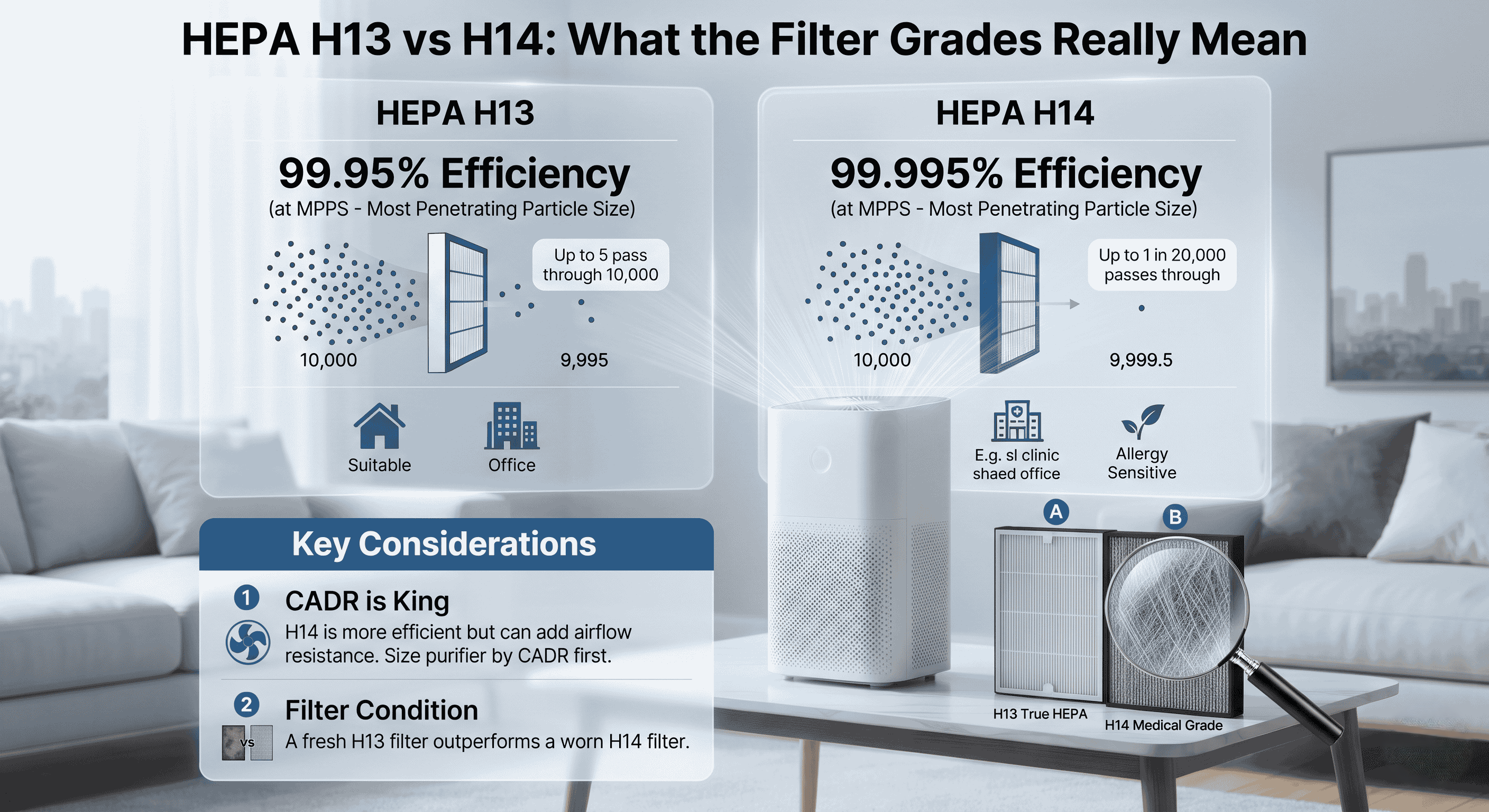
In HEPA H13 vs H14, the difference is capture efficiency: under the European EN 1822 standard, H13 filters stop at least 99.95% of the most penetrating particles and H14 filters at least 99.995%. For most homes the gap is small, and room-size CADR matters more than the grade. This guide explains the numbers and when H14 is worth considering.
Image: a comparison diagram of particles passing through H13 and H14 filters. Alt text: "HEPA H13 and H14 filter efficiency compared".
EN 1822 grades a filter at the particle size it catches least well, called the most penetrating particle size (MPPS). That is a stricter test than a single fixed size. The US "True HEPA" label is different: it refers to 99.97% capture at 0.3 µm.
| Grade | Minimum efficiency at MPPS | Share that passes through |
| H13 | 99.95% | up to 5 in 10,000 |
| H14 | 99.995% | up to 1 in 20,000 |
| US True Hepa | 99.97% at 0.3 µm | up to 3 in 10,000 at 0.3 µm |
The last column is simple arithmetic from the percentages. The test conditions differ, so the US figure and the EN 1822 figures are not directly interchangeable.
One H13 unit stops almost everything that reaches it. What decides indoor results is how much air passes through the filter each hour, which is the CADR. A H14 filter in an undersized purifier cleans a room more slowly than an H13 filter in a correctly sized one. Size first with the room-size guide, and check how CADR relates to coverage in CADR vs room coverage.
H14 is higher in efficiency but can add airflow resistance, which may reduce CADR or increase noise unless the fan is stronger. Check the CADR figure for the specific model rather than assuming a higher grade is faster.
In each case, confirm what the label claims and whether the grade is tested to EN 1822. Terms like "HEPA-type" or "HEPA-like" are not a grade.
A fresh H13 filter outperforms a worn H14 one. Guides commonly put HEPA life at 6 to 12 months, and smog seasons can shorten that. Read when to replace an air purifier filter and the guide on dust, smoke and allergens for what the filters can and cannot remove.
H14 captures a higher share of the most penetrating particles. The practical gain depends on room size, CADR and filter condition.
They are close but not identical. True HEPA is tested at 0.3 µm, while H13 is tested at the most penetrating size.
Prices vary by model and provider. Compare listings rather than assuming a price gap.
No. Activated carbon handles some gases, so check for a carbon layer if odours matter.
Choose the grade you can verify, size the unit by CADR and keep the filter fresh. H13 covers most homes, and H14 is a refinement rather than a requirement. Replacement timing then decides performance, so read when to replace an air purifier filter.
 Welcome to Rentit4me

