 23-Nov-2026
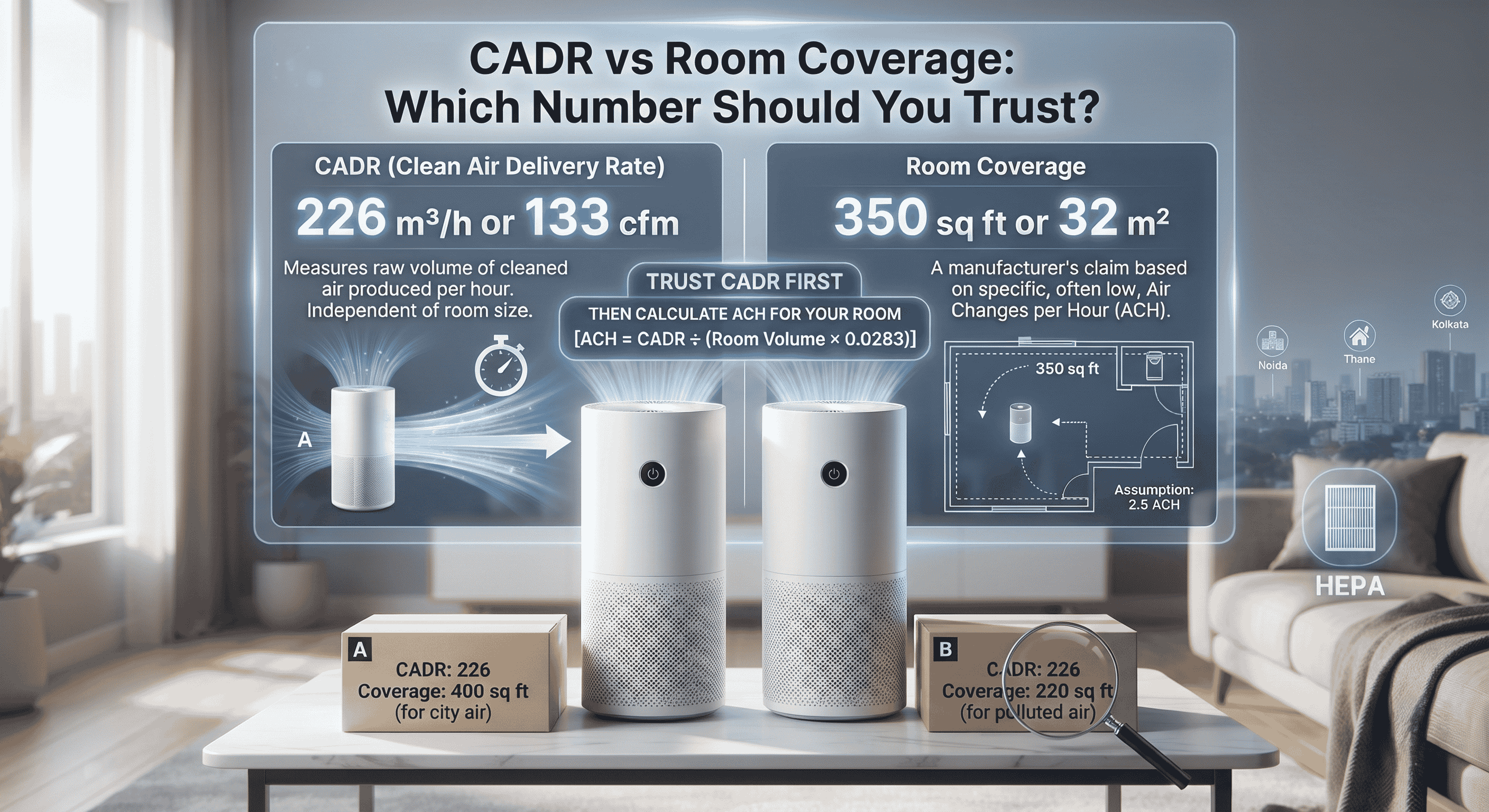
CADR vs room coverage comes down to this: CADR is the volume of clean air a purifier delivers per hour, while a room coverage figure is a claim about how large a room that purifier can serve at some number of air changes. Trust CADR first, then convert it into air changes for your own room. A box that says it covers 400 sq ft with a CADR of 226 m³/h delivers only about 2.5 air changes an hour in an 8 ft room.
Image: two boxes with the same CADR but different coverage claims. Alt text: "CADR and room coverage compared for the same air purifier".
| Measure | What does it tell you | What does it hide |
| CADR | Clean air delivered per hour, in m³/h or cfm | Nothing about your room size |
| Room Coverage | The largest room the maker says the unit suits | The air changes per hour it assumes |
CADR is the more comparable figure because it does not depend on a room. Coverage is a convenience figure, and makers may assume a low ACH to claim a larger area.
Use the same formula as the sizing guide, rearranged:
ACH = CADR ÷ (floor area × ceiling height × 0.0283)
For a 400 sq ft room with an 8 ft ceiling, the denominator is about 90.6. A 226 m³/h unit gives 2.5 ACH. A 453 m³/h unit gives 5 ACH. Guides for polluted cities recommend 5 to 6 ACH, so the coverage claim on the first unit is optimistic for city air. The formula is from Tech Mitra.
If a figure is in cfm, multiply by 1.7 to get m³/h, because one cfm is about 1.7 m³/h.
The listing reviewed for this article covers a large-space unit, and the Patan combo lists coverage of up to 350 sq ft. Ask each provider for the CADR behind a coverage claim like that.
For offices, the target changes. See air purifier for home vs office.
A higher CADR cleans faster, but it also costs more and may run louder. Match it to your room's volume.
Makers may assume fewer air changes per hour. Divide CADR by your room volume to see the real ACH.
No. CADR measures airflow of cleaned air, while filter grade such as H13 or H14 measures capture efficiency. Read HEPA H13 vs H14.
Ask for the CADR at each speed and the room size it assumes.
Use CADR as the number you trust, and treat room coverage as a starting point to check. Once airflow is settled, the next detail is the filter itself, so compare HEPA H13 and H14.
 Welcome to Rentit4me

