 26-Nov-2026
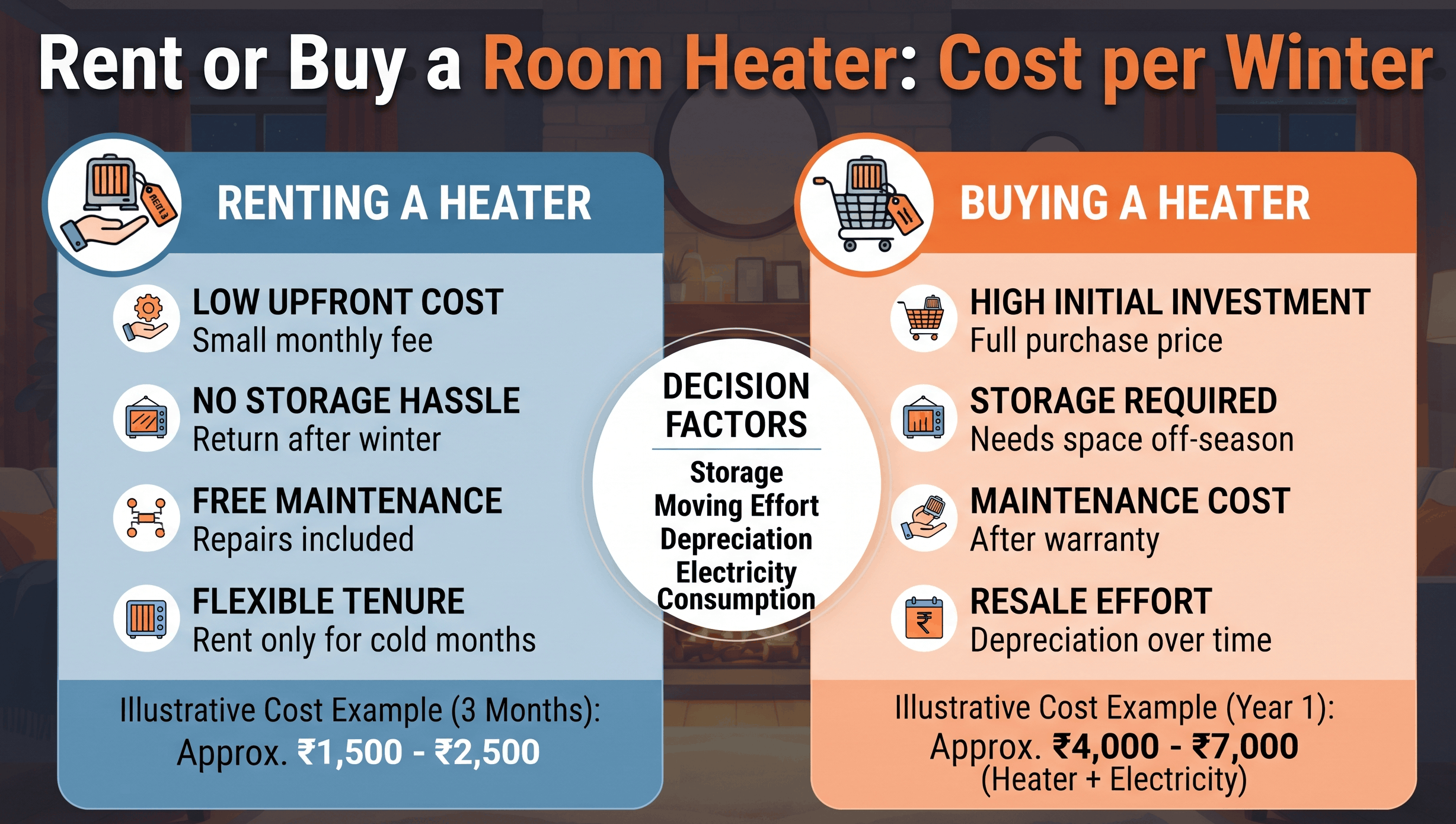
Whether to rent or buy a room heater depends on cost per winter: renting wins over one or two short winters, while buying wins over many years. The deciding number is cost per winter of real use, not the shelf price. This article shows how to calculate that number, including storage, resale and running cost.
Everything starts with the number of weeks you need heat. The Ministry of Health and Family Welfare describes the cold wave season as November to March, most frequent in December and January, across 17 states and union territories in its public health advisory. In practice, the need is shorter than that. Delhi and Ghaziabad may need serious heating for ten to twelve weeks, while Bhopal and Indore often need it for only a few cold-snap weeks.
Write your own number down before comparing prices. A heater used for four weeks a year costs far more per use than one used for twelve.
The price tag is only the first cost. Four more items sit behind it. Storage takes space for nine months in a small flat. Moving a bulky radiator adds effort, and some people leave it behind. Resale returns only a fraction of the price, because second-hand heaters sell slowly. Finally, a cheap unit may fail during a cold wave, which means buying again at peak prices.
Divide the total by the number of winters you will actually use the heater. If your lease ends in eleven months, that number is one.
Add the monthly fee for the months you need, plus any delivery charge. Then check what the plan includes, such as maintenance, replacement on failure and pickup at the end. The value of not storing or reselling the unit belongs in the calculation too.
For example, a tenant in Gurugram on a one-year posting needs a heater for about three months. A heater on rent in Gurugram removes the storage and resale steps entirely.
Electricity costs the same whether you rent or own, so it does not change the comparison. It does change your budget, so estimate it with a simple formula.
Running cost = kilowatts × hours per day × days × tariff per unit
As an illustration, assume a 1.5 kW heater, five hours a day, 60 days and a tariff of ₹8 per unit. That gives 1.5 × 5 × 60 = 450 units, or ₹3,600. Replace the tariff with the rate on your own bill. A thermostat lowers the real figure, because the element switches off once the room is warm.
Buying makes sense in three situations:
You own your home and will stay for several winters.
You live where heating runs for four or five months.
You need heaters in several rooms for years.
Renting makes sense in these situations:
Your lease is 11 months or shorter.
You are on a posting, a course or a contract.
Your cold season is short, as in much of central India.
You are unsure which type or wattage suits the room.
Some people rent in the first winter to learn what the room needs. They then buy in the second year if they are staying. That approach costs less than buying the wrong heater.
Sealing door gaps, hanging heavy curtains and laying a rug cut heat loss and therefore heating hours. The guide to keeping a rented flat warm in winter lists twelve such fixes.
Numbers are easier to trust when they come from real situations, so consider three households. The first is a couple in Delhi on an 11-month lease who need heat for about ten weeks. Buying means a purchase, a space in a small flat for nine months and a resale attempt when they leave. Renting means paying only for the weeks they actually need and returning the unit.
The second is a family in Chandigarh who own their home and need heat for twelve weeks every year. Over five winters, a durable heater with a thermostat is likely to cost less than five rental seasons. They also avoid delivery and pickup each year. The third is a student in Indore who needs a heater for only four cold-snap weeks. In that case, renting avoids paying for an appliance that will sit idle for most of the year.
The pattern is clear. Short seasons and short stays favour renting, while long ownership of a home with a long season favours buying. Your own figures will fall somewhere between these cases, so work through them with real quotes before you decide.
A plan is only as good as its terms, so ask five questions before you agree. First, what does the monthly fee cover, and is delivery or pickup charged separately? Second, who pays if the heater fails during a cold wave, and how quickly is it replaced? Third, is there a deposit, and when is it returned?
Fourth, what is the minimum period, and can it be extended if winter runs long? Fifth, which models are offered, and do they have a thermostat and a tip-over switch? Keep the answers in writing, because a clear record settles most disputes before they begin.
Several errors skew the maths. People compare the rental fee with the shelf price and forget storage, resale and replacement. They assume electricity is cheaper when they own the heater, even though the bill is identical. They also forget that a cheap unit without a thermostat can cost more to run than a better one, because it draws full power continuously.
Another common error is counting the whole winter instead of the real heating weeks. A heater that runs for three hours on thirty evenings does not cost as much as one that runs all day for ninety days. Count hours, not months, and the comparison becomes far more accurate.
For one or two short winters, renting is usually cheaper once storage, resale loss and failure risk are counted. Over five or more winters, buying a durable unit can cost less. The break-even depends on your heating weeks and the rental plan.
No. A rental covers the heater itself, and you pay for the electricity through your own meter. Use the running-cost formula above to estimate the bill for your tariff. Choosing a thermostat model keeps the running cost lower, because the element switches off once the room is warm.
Extensions are usually possible when you ask before the tenure ends. Cold spells in February and early March are common in north India, so confirm the extension terms when you choose the plan. Asking early also keeps the same unit in your room without a gap in delivery.
Check the early-return terms before you sign. Some plans adjust the fee for the unused period, and others charge a minimum. Ask how pickup is arranged if you move out, and keep that answer in writing so that a change of address does not turn into an avoidable charge.
Not always. A low-priced unit without a thermostat runs at full power the whole time, so it can use more electricity than a better unit that cycles on and off. It may also fail sooner. Compare the running cost and the expected life together, not the shelf price alone.
The cheapest option is the one with the lowest cost per winter of real use. Short stays, short seasons and uncertain needs favour renting, while long stays in a home you own favour buying.
To decide whether to rent or buy a room heater, count storage, resale and running cost, and keep your heating weeks honest. Then pick the heater that suits the room. For that step, the guide to room heater types compares the four common designs and explains where each one works best.
 Welcome to Rentit4me

