 26-Nov-2026
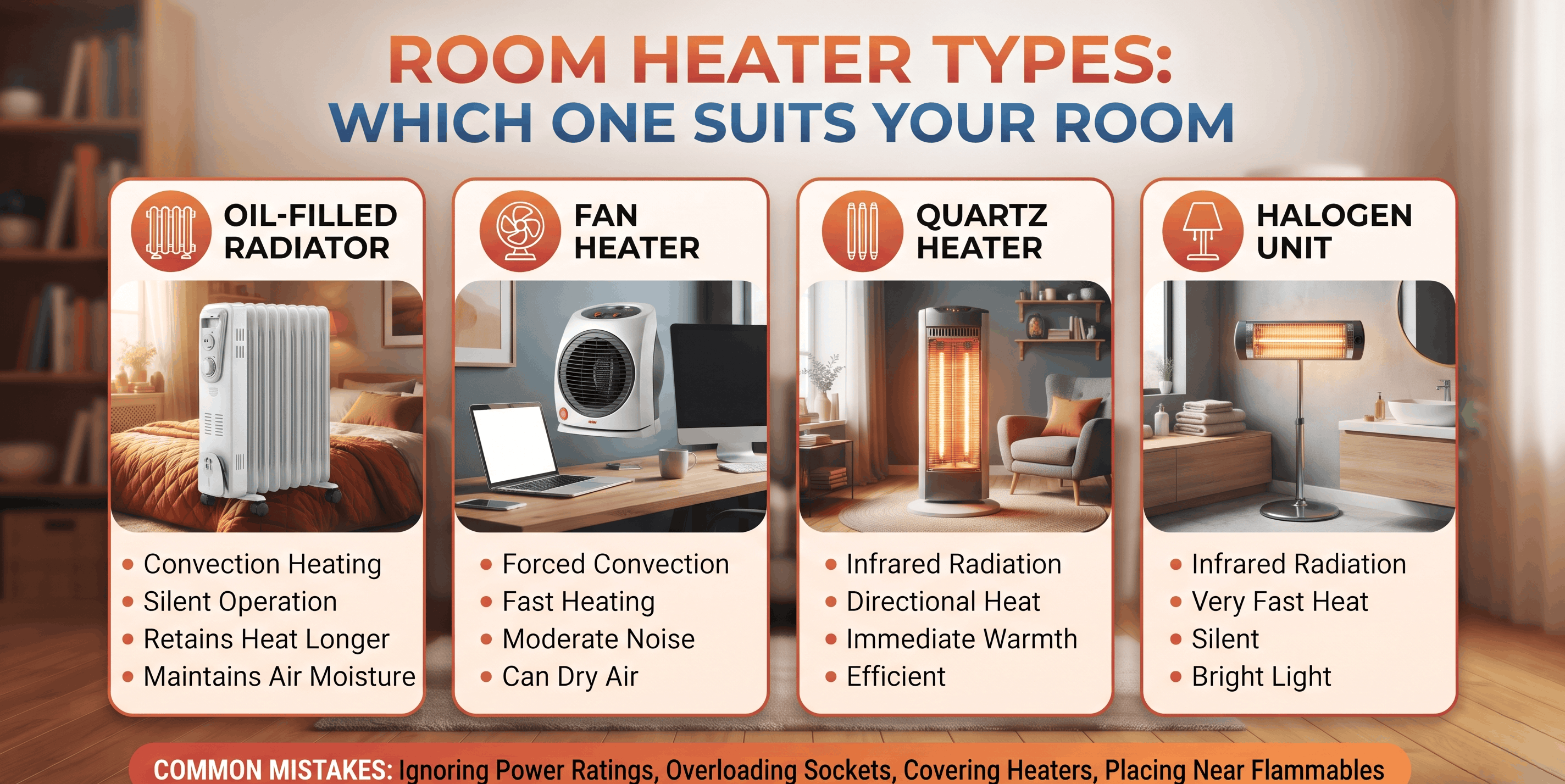
The four main room heater types are the oil-filled radiator, the fan heater, the quartz heater and the halogen heater. Each one warms a room differently, so the right choice depends on the space and how long you stay in it. This guide explains how each type works, where it performs well, and where it falls short.
Heaters warm you in two ways. Convection heats the air, and the warm air then circulates around the room. Radiation sends infrared heat straight to people and objects, without heating much air on the way.
Oil-filled radiators and fan heaters rely mainly on convection. Quartz and halogen heaters rely mainly on radiation. As a result, convection types suit whole rooms, while radiation types suit one seat or one spot.
Most disappointment with heaters comes from mixing these up. A quartz heater in a large bedroom feels weak because it warms only what stands in front of it. A fan heater in a study feels harsh because it dries the air.
An oil-filled radiator heats sealed thermal oil inside metal fins, and the fins release heat steadily. The oil never needs refilling. Because the fins stay warm for several minutes after the thermostat cuts power, the room temperature stays even.
This type suits bedrooms and closed rooms where you spend an hour or more. It runs silently and dries the air less than an exposed element. However, it takes 15 to 30 minutes to make a noticeable difference, and it is heavy to move.
A fan heater blows air over a hot element and throws warm air into the room within a minute. It is light, portable and cheap to run for short bursts. Therefore it works well in a bathroom corner, a dressing area or a small study.
The drawbacks are noise and dryness. The room also cools quickly once you switch it off, so it is a poor fit for long sessions.
A quartz heater uses a glowing tube behind a reflector. A halogen heater uses a halogen lamp and often oscillates. Both deliver direct infrared warmth to whoever sits in front of them.
They suit a desk, a study table or a sofa corner, where you stay in one place. In contrast, they do little for the rest of the room. The glowing element also makes them a poor choice around children and curtains.
Match the type to the situation, not to the wattage alone. A bedroom of 120 square feet suits an oil-filled radiator that you switch on before you enter the room. A work-from-home desk suits a quartz heater aimed at your legs.
Many households use two heaters: one oil-filled unit for the main room and one small fan or quartz unit for a work corner. Renting makes that pairing easy to change each winter. Renters in Noida and Gurugram often pair a radiator with a desk heater for work-from-home days.
Whatever the type, look for the BIS safety mark. The Bureau of Indian Standards covers room heaters under IS 302-2-30, which sets safety requirements for convector, fan and radiant heaters.
Cold behaves differently across north and central India. In Delhi and Ghaziabad, fog and closed windows favour quiet convection heaters. In Chandigarh and Mohali, nights are cold but afternoons are warm, so a timer matters more than a large heater.
A worked example makes the choice clearer. Take a 110 square foot bedroom in a flat where the family sleeps by 10 pm. An oil-filled radiator with a thermostat, switched on at 8:30 pm, brings the room to a comfortable level by bedtime. The heater is then switched off, and the stored warmth in the room and the bedding carries through the first part of the night.
Now take a 70 square foot study used from 10 am to 5 pm. A radiator would take long to matter there. A quartz heater aimed at the legs gives faster comfort at a lower load.
A bathroom is different again. Water and mains heaters do not mix, so the better habit is to warm the dressing area outside the bathroom with a short burst from a fan heater, then switch it off before anyone bathes. A living room of 250 square feet usually needs two units or a spot approach, because one heater cannot overcome the volume of air and the number of doors.
Four mistakes appear again and again. The first is buying by wattage alone, which ignores whether the heater suits the way the room is used. The second is placing a radiation heater in the middle of a room, where it warms nothing in particular. The third is skipping the thermostat, so the room swings between hot and cold.
The fourth is ignoring the socket. Many older flats and PGs have wiring that was never designed for a heavy load, so a heater plugged into a worn point can overheat the plug before it warms the room. Therefore, check the socket and the cord first, and keep the heater on a wall point instead of an extension board.
Timing matters as much as type. In Delhi and Ghaziabad, the cold is sharpest from mid-December to the end of January, so most households need a heater only on those nights and mornings. In Chandigarh and Mohali, evenings turn cold early, and a timer that warms the room before you return is more useful than all-day heating.
In central India, cold snaps are short. Households in Bhopal and Indore often need a heater for only a few weeks, so compare short-term options before buying a unit that will sit in storage.
Wattage decides running cost, not type. A 1,000 W heater uses one unit of electricity per hour at full power, whichever type it is. A thermostat reduces consumption because the element switches off once the room reaches the set temperature. Therefore a thermostat model of any type usually costs less to run than one without.
No. The oil sits in a sealed circuit and never needs topping up. Opening the unit is unsafe and usually voids the warranty. If oil leaks from the body, stop using the heater at once and have it checked by a technician before it goes back into service.
Fan heaters and halogen heaters dry the air most, because they run hot and move or radiate heat quickly. Oil-filled radiators dry it least, since their surface stays cooler. A bowl of water in the room helps with any type, and a short ventilation break in the afternoon helps too.
Rarely. A single heater warms one room, and heat escapes through doors, windows and gaps. As a result, the practical approach is to heat only the room you use and keep its door closed. A second small heater can cover a work corner without raising the load on one socket.
An oil-filled radiator with a thermostat and a tip-over switch is the common choice, because its surface is cooler and it makes no noise. Even so, keep it well away from the cot, never leave it on while the baby sleeps, and warm the room beforehand. A room thermometer helps you avoid overheating.
The right room heater type follows the room and the routine. Oil-filled radiators suit bedrooms, fan heaters suit short stays, and quartz or halogen units suit a single seat. Wattage, a thermostat and a tip-over switch matter as much as the type itself.
 Welcome to Rentit4me

