 05-Oct-2026
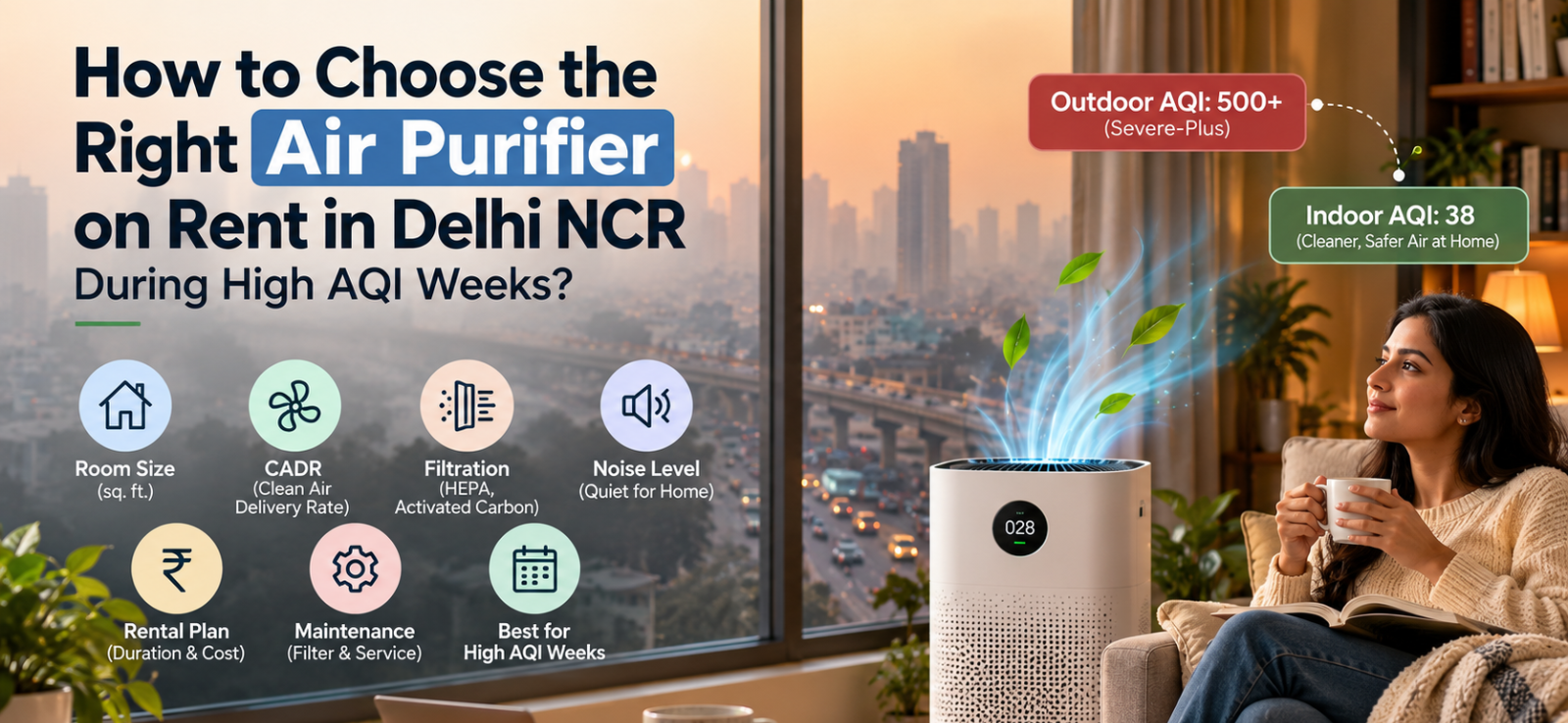
A genuine True HEPA H13 filter with an activated carbon layer, size it to your room using CADR (not the vague "coverage area" number on the box), and during Delhi's worst AQI weeks, pick a unit with 20-60% more CADR than the standard recommendation because during severe smog, an undersized purifier just runs flat-out without ever really catching up. If you only need this kind of protection for the winter stretch, renting makes a lot more sense than buying outright.
Walk past the marketing language and there are really only two technical things worth checking.
True HEPA H13 (or H14): This is non-negotiable for Delhi. A certified True HEPA H13 filter captures 99.97% of particles down to 0.3 microns which covers PM2.5, the fine particulate matter that's the main health concern in Delhi's smog. The catch: a lot of budget units use vague labels like "HEPA-type" or "HEPA-like" instead of an actual H13/H14 certification. Those aren't the same thing, and the difference matters specifically here, where particle concentration gets genuinely dangerous during peak weeks.
Activated carbon: HEPA filters trap particles, but they don't do much for gases, VOCs, or smoke smell and stubble-burning season brings exactly that kind of airborne chemical load along with the particulate matter. A purifier without a decent activated carbon layer will filter particles fine but leave that acrid smoke smell hanging in the room. If you've ever wondered why a purifier is running but the air still smells like something's burning outside, this is usually why.
CADR stands for Clean Air Delivery Rate, it tells you how much actually-clean air the unit pushes out, measured in cubic metres per hour (m³/h) or CFM. This is the single most useful spec for comparing purifiers, far more than the "covers up to X sq ft" claim printed on the box, which manufacturers tend to measure under ideal conditions that don't reflect Delhi's actual pollution load.
As a rough guide for everyday Delhi air:
Here's the part most generic buying guides skip entirely, because it's specific to places like Delhi: during genuinely severe AQI weeks, when AQI is sitting at 300+ for days at a stretch. you want 20-60% more CADR than the standard recommendation for your room size. The reason is simple: a purifier sized exactly to "normal" conditions ends up running at maximum fan speed constantly during a smog spike, working flat-out and never quite catching up, which is both less effective and noisier than a unit with some headroom to spare.

Before getting into CADR and filter specifications, it is worth asking a more basic question: why rent an air purifier instead of buying one?
For someone who expects to use a purifier for several years, buying can make sense. The calculation is different for someone whose requirement is temporary. Consider a professional who has moved to Gurgaon for a six-month assignment. Or a student renting a room in Noida for one academic year. Or a family that normally does not use an air purifier but wants additional indoor particle filtration during the more polluted part of Delhi's winter.
In these situations, buying means committing to the appliance even after the immediate need disappears. There is also the question of filter replacement, maintenance, storage and eventually moving the machine to another home. A rental air purifier offers another route. You use the appliance while the need exists and return it when the rental requirement ends.
That does not automatically make renting cheaper than buying. A long rental can cost more than ownership. The value of rental is often its flexibility and lower commitment, particularly for temporary stays and seasonal use.
This is where a lot of people get it wrong not because they don't understand CADR, but because they underestimate how room size interacts with ceiling height and how open the space is. A purifier that's technically rated for your square footage under lab conditions often underperforms in a real room with furniture, partial partitions, or higher ceilings.

A practical way to think about it, by the kind of space you're actually purifying:
On Rentit4me, this maps closely to what's actually available: compact units for single-room coverage, mid-capacity options for larger bedrooms or home offices, and higher-capacity purifiers for living rooms and open-plan spaces so you're choosing based on your actual room rather than guessing from a generic size chart.
A reasonable rule of thumb: once AQI in your area starts regularly crossing 150-200, which in Delhi NCR typically starts well before the "severe" headlines hit, it's worth having a purifier running continuously rather than only on the days it visibly looks smoggy outside. By the time smog is visibly hanging in the air, indoor particle levels have usually already been climbing for a while, since indoor air tracks outdoor air closely in most homes that aren't fully sealed.
Choosing the right air purifier on rent in Delhi NCR really comes down to three things: a genuine HEPA H13 filter with activated carbon, a CADR that's actually matched to your room with some headroom for the worst weeks, and a rental tenure that fits how long you actually need the protection rather than committing to year-round ownership. Get those three right, and you've covered what actually matters everything else is mostly marketing language layered on top.
 Welcome to Rentit4me
