 18-Sep-2026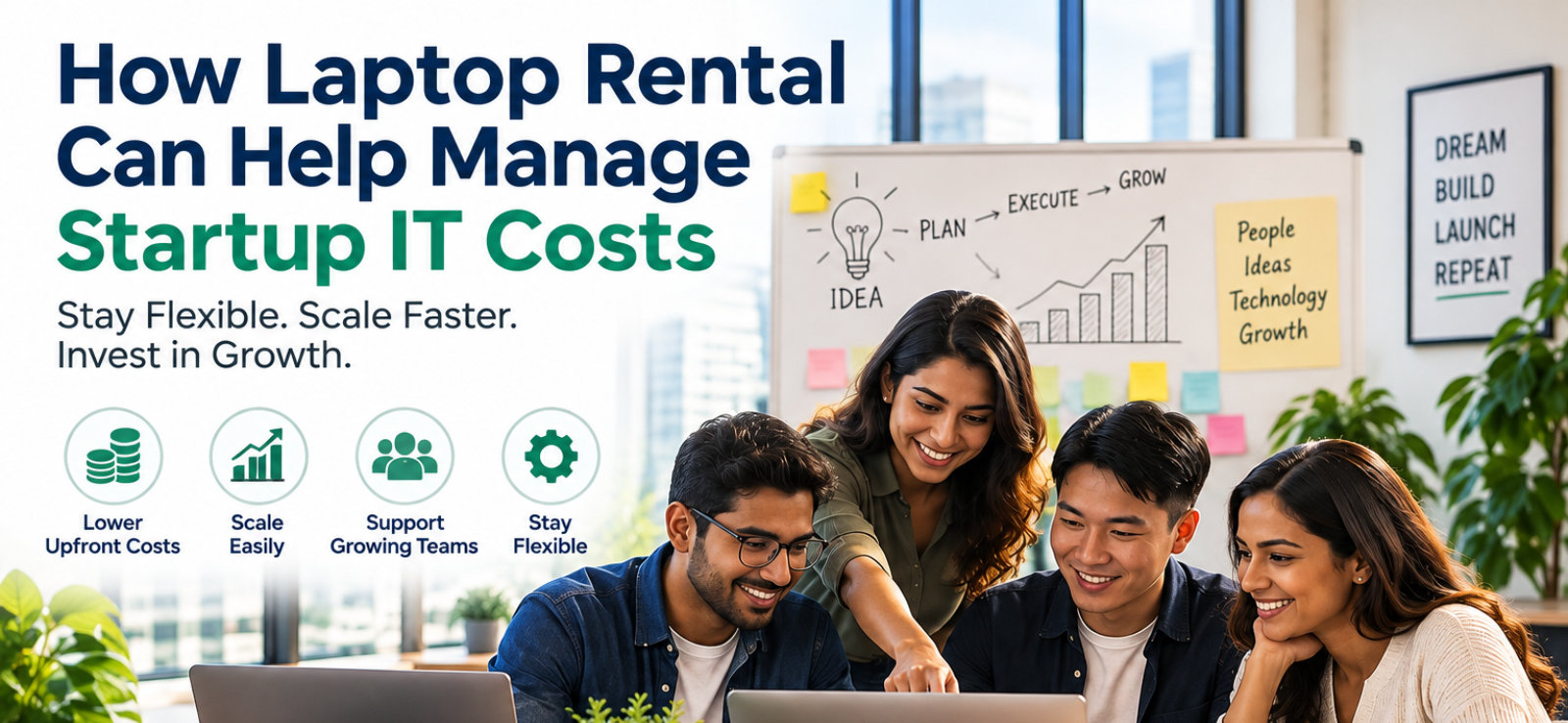
For a startup, buying laptops can look like a straightforward business expense. You hire five employees, buy five laptops, hand them over and move on. The problem begins when the startup stops growing according to the original plan.
A new team is hired sooner than expected. A client project requires ten additional people for six months. An intern joins for the summer. A consultant needs a machine immediately. A remote employee is working from another city. One of the existing laptops fails just before an important presentation.
Suddenly, laptops are no longer simply an IT purchase. They become part of the startup's cash-flow planning, hiring process, project management and operational flexibility. This is where laptop rental for startups can become relevant.
The argument for renting is not necessarily that renting makes every laptop cheaper than buying one. Current discussions around startup IT procurement increasingly frame the decision around cash flow, headcount uncertainty, equipment lifecycle, deployment speed, support and total cost of ownership rather than purchase price alone.
Laptop rental can help startups manage IT costs by reducing the upfront hardware commitment, letting the fleet scale up or down with hiring, and matching equipment spend to project duration rather than a fixed purchase. It isn't automatically cheaper than buying the right model depends on how long the devices will be used, how stable headcount is, and the total cost over that period, not just the monthly rate.
One of the biggest challenges with startup IT spending is that the requirement can change faster than the procurement cycle. Imagine a company that begins the year with ten employees and plans to reach twenty-five by the end of the year. The founders have two basic options. They can purchase laptops only for the employees they currently have and then make additional purchases as the company grows, or they can buy more equipment in advance based on the expected headcount. Neither approach is inherently wrong, but each creates a different financial and operational commitment.
Buying ahead creates certainty because the equipment is already available. If five employees join next month, the machines can simply be assigned to them. The company then has to manage storage, reassignment, resale or additional procurement.
The same issue exists with projects. A startup might win a six-month implementation contract and suddenly need ten additional laptops. Once the project ends, those ten devices may no longer be required. When equipment demand changes according to short-term business opportunities, the traditional model of purchasing every device may not always align with the way the company actually operates.

The difference between purchasing and renting is often discussed as a question of total cost, but for startups, the timing of the expenditure can be just as important. Purchasing a laptop requires the business to commit to the hardware immediately, whereas rental allows the cost to be distributed across the agreed rental period. The total amount paid over time may be higher than the initial purchase price, depending on the device and contract, but the company is not necessarily required to make the same size upfront commitment.
The important point is that rental changes the structure and timing of the commitment; it does not eliminate the cost. This is why startups should avoid simplistic claims that laptop rental is always cheaper. The real question is whether the financial flexibility and operational convenience of renting are valuable enough for the company's particular situation.
Startup founders often talk about runway in terms of salaries, marketing, product development and infrastructure.
Hardware can quietly become another major cash requirement.
Suppose a company has limited working capital and must decide where to allocate its available cash. Spending heavily on hardware that may sit unused for months can create an opportunity cost.
The money tied up in unused laptops could otherwise be available for recruitment, product development, sales, customer acquisition or operational reserves.
This is one reason several startup-oriented rental models describe equipment rental in terms of preserving runway and avoiding large upfront commitments.
However, preserving cash does not mean choosing the cheapest possible device.
A laptop that causes developers to lose productivity, slows down creative work or creates reliability problems can become more expensive operationally than its purchase price suggests.
The objective should be to control total technology spending while giving employees appropriate equipment for their roles.
Unused laptops often appear harmless once they have already been purchased. A device sitting in a cupboard does not generate another invoice every month, so its cost can become invisible. From a financial perspective, however, the money spent on that device remains tied up in an asset that is producing little immediate value.
There is also a lifecycle consideration. Technology continues to age even when it is sitting unused. Batteries deteriorate, hardware generations change and software requirements evolve. A machine bought today for an employee who might join six months later could still be sitting unused when newer models become available.
A startup that repeatedly purchases ahead of demand can therefore end up with a strange situation: it has hardware available, but some of that hardware may not be the best fit for current employees or current workloads.
Rental can provide one possible way of handling additional or temporary demand without permanently expanding the owned fleet.
Cost management is not only about deciding whether to rent or buy. It is also about deciding what hardware to provide in the first place.
Many businesses simplify procurement by standardising on a single laptop configuration for everyone. There are clear administrative advantages to this approach. IT teams can maintain fewer device types, accessories can be standardised and employees can be moved between roles more easily.
However, universal specifications can also lead to unnecessary spending.
A salesperson may spend most of the working day in a browser, CRM platform, video calls and office applications. A developer may need more memory, processing power and storage. A designer may have substantially different requirements, particularly when dealing with large creative files. A financial analyst may require strong multitasking capability but not the same graphics performance as a creative professional.
The goal should be role-appropriate hardware.
This can reduce unnecessary spending by preventing every employee from receiving the highest specification available. At the same time, it avoids the opposite mistake of giving demanding roles hardware that cannot comfortably handle their workloads.
There are several situations in which laptop rental becomes particularly relevant.
Rapid hiring is one. A startup expecting a major expansion may not want to purchase an entire future workforce's hardware immediately. Temporary projects are another. When additional laptops are required for a fixed engagement, the company has a clear reason to consider whether permanent ownership is necessary. Temporary employees, contractors and interns create a similar question. Their hardware requirement may be real but short-lived.
Startups with limited upfront capital may also consider rental because it can change the timing of hardware expenditure. This can be valuable when several business priorities are competing for the same cash. A startup with distributed teams may additionally consider rental if a provider can support deployment, replacement and return logistics across multiple locations.
Finally, companies that are still learning what hardware their teams actually require may value flexibility. A startup does not always know at the beginning whether its developers will standardise on one operating environment, whether a creative team will require higher-performance machines or how many devices will be needed during different phases of the business.
A good hardware strategy starts with understanding demand. The first step is to document the number of employees who currently require company-provided laptops. The second is to separate confirmed hiring from projected hiring. The third is to identify temporary workforce requirements and project-specific hardware needs.
Next comes role mapping.
The startup should understand which roles require standard business hardware and which require higher specifications. This can prevent both under-provisioning and unnecessary over-provisioning. The financial comparison should use the same time period and comparable hardware. If a three-year purchase cost is being compared with a six-month rental price, the result will obviously be distorted.
It is easy to describe laptop rental as a way to reduce IT costs. That description is incomplete.
The objective is to build a hardware model in which financial commitments match actual business requirements as closely as possible. That may mean owning core equipment, renting temporary capacity and adjusting the balance as the company grows.
The company does not simply need a device for every employee. It needs a hardware strategy that can cope with changing headcount, different roles, temporary projects, evolving workloads and competing financial priorities.
Laptop rental for startups can be useful because it introduces another way to manage that uncertainty.
Instead of making a large hardware commitment based entirely on projected growth, a startup can consider aligning equipment with actual demand. It can evaluate rental for temporary employees, short-term projects, contractors, training requirements or periods of rapid hiring, while continuing to purchase hardware where long-term ownership makes more financial sense.
 Welcome to Rentit4me
