 11-Sep-2026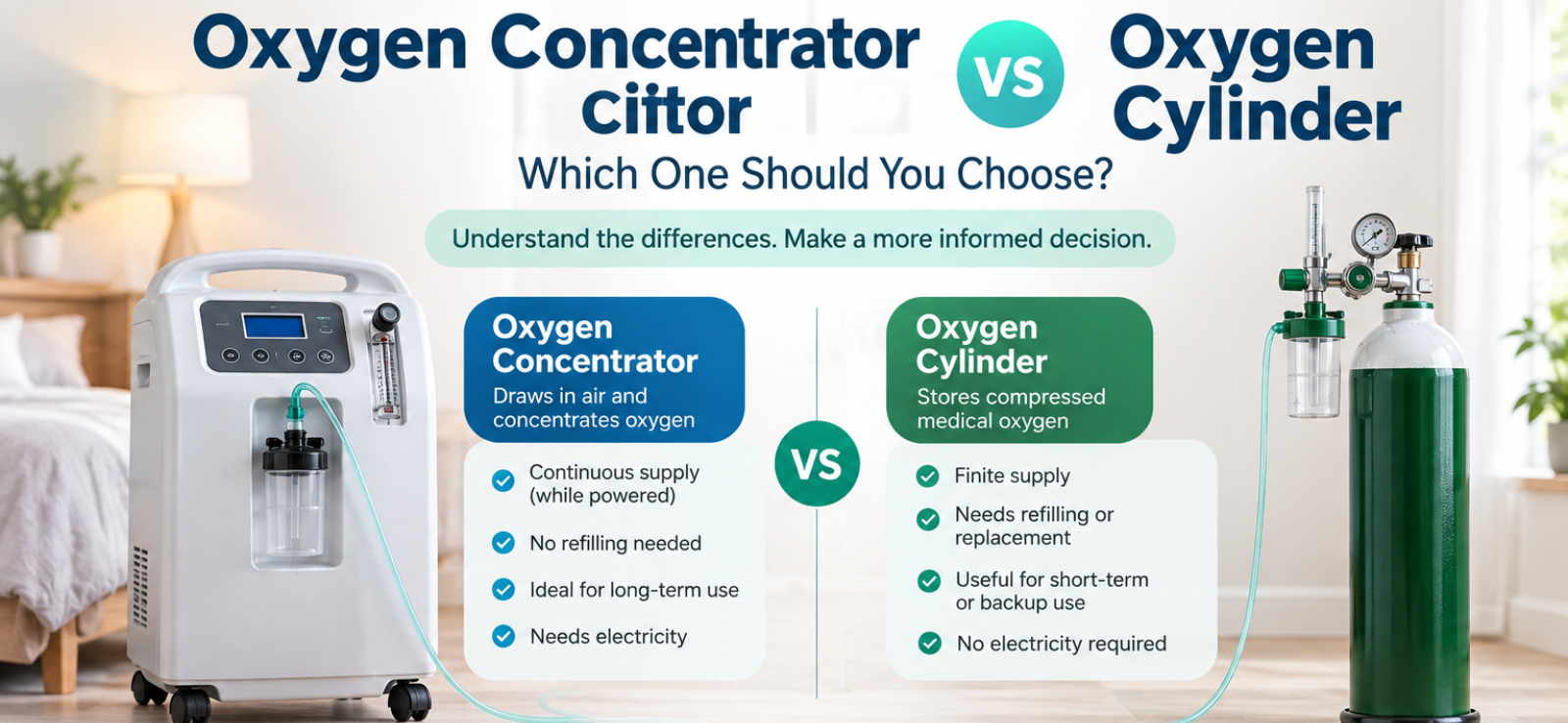
An oxygen concentrator may be practical for prescribed longer-duration oxygen therapy when a reliable power supply is available. A cylinder may be useful when stored oxygen, portability or power-independent backup is important.
Both are used to deliver supplemental oxygen, but they work in very different ways. An oxygen concentrator draws in air from the surrounding environment and concentrates oxygen for delivery, while an oxygen cylinder stores a finite supply of compressed oxygen. The right choice depends on the patient's prescribed oxygen requirement, how frequently oxygen is needed, how long it is expected to be used, mobility requirements, electricity availability and the overall home-care plan.
This guide explains the actual difference between an oxygen concentrator and oxygen cylinder, how each works, what happens during a power cut, how cylinder size and concentrator capacity affect the choice, and what to consider before renting oxygen equipment for home use.

An oxygen concentrator is a medical device that draws in surrounding air, separates out much of the nitrogen and delivers an oxygen-enriched gas stream to the patient. Unlike an oxygen cylinder, it does not depend on a fixed volume of oxygen stored inside a tank. A standard home concentrator needs electrical power to operate.
This makes an oxygen concentrator particularly useful in situations where oxygen has been prescribed for extended periods at home and an appropriate electrical supply is available.
The LPM figure refers to the device's flow capability. It should not be interpreted as a recommendation for the amount of oxygen an individual patient should receive.
How an Oxygen Concentrator Works
At a simplified level, the process is:
Room air → filtration → nitrogen separation → oxygen-enriched gas → oxygen delivery tubing → patient
The oxygen is usually delivered through a nasal cannula or mask, depending on the prescribed setup. A concentrator therefore replaces the need to repeatedly refill an oxygen tank with a different requirement: electricity and a functioning machine.

An oxygen cylinder is a pressurized container that stores compressed medical oxygen. Unlike a concentrator, the cylinder does not extract oxygen from room air. It supplies oxygen that has already been stored inside the cylinder through an appropriate regulator and delivery setup.
Cylinders are available in different sizes. A smaller cylinder contains less oxygen, while a larger cylinder contains more. The appropriate size depends on the patient's prescribed oxygen requirement, expected duration and practical use. One major advantage is that an oxygen cylinder does not depend on mains electricity to deliver the stored oxygen. The trade-off is that the supply is finite.
The difference becomes much easier to understand when you compare the practical questions a family has to deal with every day.
A standard home oxygen concentrator requires electricity to operate. If the power supply is interrupted, the concentrator cannot continue functioning normally unless an appropriate backup power arrangement is available. And an oxygen cylinder is different because it already contains stored oxygen. It does not need mains electricity to release that oxygen through the prescribed delivery system.
This is perhaps the simplest distinction. An oxygen concentrator continuously extracts and concentrates oxygen from room air while the machine is powered and functioning. But A cylinder provides oxygen from a fixed stored supply.
With a concentrator, the main concerns are:
Power → machine operation → prescribed flow → maintenance
With a cylinder, the concerns include:
Cylinder capacity → prescribed flow → remaining supply → refill/replacement
An oxygen concentrator does not need to be refilled with oxygen because it generates its oxygen supply from the surrounding air. A cylinder eventually does. This can make a concentrator convenient for some longer-term home arrangements because the family does not have to schedule oxygen refills in the same way.
A standard home oxygen concentrator is generally designed to stay in one location. A portable oxygen concentrator, or POC, is a separate type of device designed specifically around mobility and may operate from rechargeable batteries as well as an electrical outlet. Some portable concentrators provide pulse-dose oxygen, while certain models can provide continuous flow.
For many Indian households, this is one of the most practical differences. A concentrator depends on electricity. A cylinder does not depend on mains electricity for the oxygen already stored inside it.
The Ministry of Health's national oxygen guidelines recognize the need for power backup and reserve oxygen when concentrators are used for long-term oxygen therapy. And The American Lung Association also notes that patients using home concentrators may have a backup oxygen tank available in case of a power outage.
A home oxygen concentrator is commonly used when a patient has been prescribed oxygen for much of the day or during sleep, provided the machine is appropriate for the prescribed requirement and suitable power is available. The NHS and American Lung Association both describe home concentrators in this context.
An oxygen cylinder can also be used at home, but it provides a finite stored supply that must eventually be replaced or refilled.
For long-term oxygen therapy, India's Ministry of Health guidelines state that oxygen concentrators are a commonly used oxygen source and note the practical advantages they can have over cylinders for long-term therapy because cylinders require refilling at intervals. The same guidance emphasises appropriate power backup and reserve oxygen.
If a patient is using a standard electric oxygen concentrator, a power cut can interrupt the machine's operation. A cylinder does not depend on mains electricity to deliver its stored oxygen. That is why a cylinder may sometimes serve as a backup oxygen source for a patient whose primary device is a concentrator. The American Lung Association specifically notes the use of backup oxygen tanks for concentrator users in the event of a power outage. For households relying on a concentrator, it is sensible to understand the backup plan before a power failure occurs.
If a patient experiences severe or sudden breathing difficulty, worsening symptoms, loss of consciousness or another medical emergency, seek urgent medical attention rather than waiting for rental equipment or attempting to solve the problem by changing oxygen devices.
Rentit4me currently lists both 5 LPM LPM oxygen concentrator and 10 LPM oxygen concentrator under Respiratory Care. The current 5 LPM listing specifies a 0.5–5 LPM flow range, while the 10 LPM listing specifies a 1–10 LPM flow range. The 5 LPM listing also specifies 280–350W power consumption, while the 10 LPM listing specifies 500–600W.
This does not mean the 10 LPM model is automatically better. It simply has a higher flow capability. The correct choice depends on the oxygen requirement prescribed for the patient.
Rentit4me currently offers a 10-litre oxygen cylinder and a 40-litre+ oxygen cylinder under its Respiratory Care category. The difference is primarily capacity and physical practicality. A smaller cylinder can be easier to handle, while a larger cylinder holds substantially more stored oxygen and may be more appropriate where a larger reserve is required.
Choosing between renting and buying is a separate decision from choosing between a concentrator and cylinder.
Renting can be particularly practical when:
Buying may make more sense when the same equipment is expected to be required repeatedly for a long period and the long-term economics justify ownership.

The device name and rental price are only the beginning.
A concentrator can provide a continuous oxygen source while powered. A cylinder provides stored oxygen without depending on mains electricity. For some patients, one may be sufficient; for others, a backup arrangement may also be appropriate.
When the requirement is temporary or the duration of oxygen therapy is uncertain, renting can provide the flexibility to access the equipment now without committing to permanent ownership before the long-term care plan becomes clear.
 Welcome to Rentit4me
