 10-Sep-2026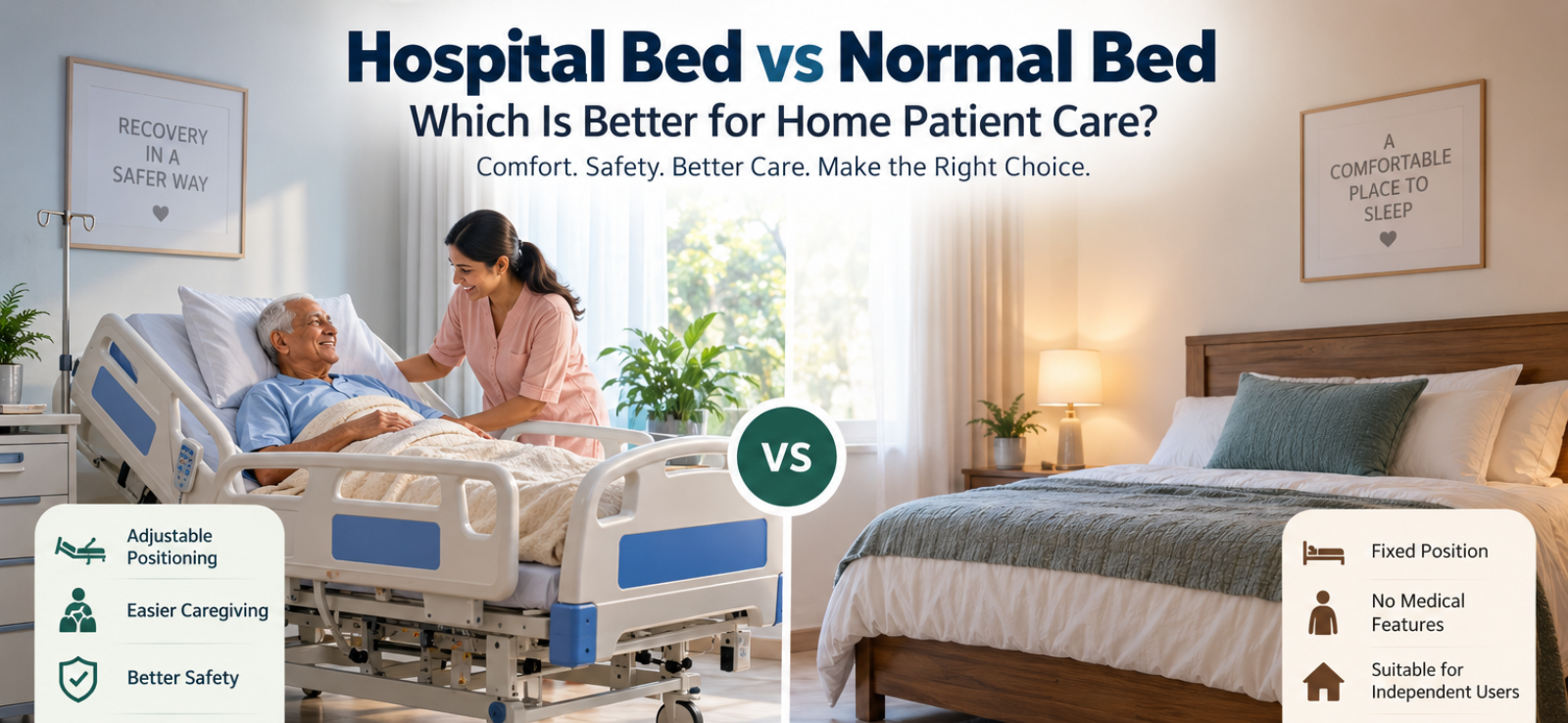
When a family member comes home after surgery, illness or a hospital stay, one of the first practical questions is often surprisingly simple: Can we manage with the bed we already have, or do we need a hospital bed? For someone who is independently mobile, a normal bed may be completely adequate. It provides a comfortable place to sleep and is familiar, simple and easy to fit into a bedroom.
The situation changes when a person begins spending most of the day in bed, needs help sitting up, requires assistance getting in and out of bed, has limited mobility or needs regular bedside care. At that point, the bed is no longer just furniture. It becomes part of the patient's everyday care environment.
A normal bed is designed primarily for sleeping and everyday comfort. It generally has a fixed frame, a fixed sleeping surface and a standard mattress. Some beds may have storage, a headboard, different heights or adjustable features, but these are usually intended around bedroom use rather than patient care.
For a healthy and independently mobile person, that is exactly what a bed needs to do. A person can lie down, sit up, turn over, get out of bed and move around without needing much assistance. In this situation, a conventional bed may be simpler and more appropriate than bringing medical equipment into the room.
A hospital bed is a medical or homecare bed designed to provide more flexibility around the patient's position and the caregiver's access to the patient. Depending on the model, a hospital bed may allow the back section, leg section or overall bed height to be adjusted. Some models include side rails and lockable castors so the bed can be repositioned when required. These functions can become useful when a person spends long periods in bed or requires assistance with routine activities.

A normal bed leaves the patient in one fixed position. A hospital bed can be adjusted so the patient sits more upright or is repositioned according to the care plan genuinely useful for patients who can't move themselves easily. How much adjustment you get depends on the model: a basic manual bed offers less range than a 5-function electric bed, so don't assume a 2-function and a 5-function bed do the same job.
A standard bed stays at one fixed height. For someone with reduced strength or mobility, that difference between a fixed-height bed and one that adjusts can determine how easily they sit at the edge, transfer to a wheelchair, or get help standing up. Actual suitability still depends on the patient's condition and the healthcare team's guidance.
Many hospital beds include side rails or side supports, which can act as an added barrier or handhold depending on the design. A normal bed may have a headboard, but not medical-style rails. Worth being clear: side rails aren't a guarantee against falls they're one part of a broader care setup, used appropriately for the patient and the bed's instructions.
This is often where the difference is felt most. Helping someone sit up, adjusting position, changing clothes or bedding, assisting with meals, helping with transfers these small tasks add up fast for a caregiver. A conventional bed wasn't built around repeated activities like these. A hospital bed makes the physical setup more workable, even if it doesn't make caregiving effortless.
Mattress choice matters more once someone spends most of the day in bed. Hospital beds can be compatible with certain medical or pressure-relief mattresses, depending on the model though not every hospital bed comes with one automatically. Mattress needs should be discussed separately with the healthcare team.
Many hospital beds have castors that lock in place, making repositioning within a room easier than moving a standard bed frame. Room layout matters too caregivers often need to approach from the side, and the room may eventually hold other equipment like a wheelchair, walker, or oxygen setup.
A hospital bed may become worth considering when ordinary bed functions no longer match the patient's day-to-day needs.
Surgery can temporarily make bending, standing, turning, or bearing weight difficult. A normal bed doesn't adapt to that. A hospital bed may allow the surface or height to be adjusted, depending on configuration, making it easier to set up a practical recovery space at home. Whether one is appropriate still depends on the specific surgery and the medical team's movement instructions.
The answer often comes down to duration. If a patient needs a hospital bed temporarily after surgery or during a defined recovery period, renting can be practical. If the requirement is expected to continue for years, buying may make more financial sense depending on the expected use and total cost.
There is also a third consideration: uncertainty. Sometimes families do not know how long the patient will need assisted care. In that situation, renting allows the family to avoid making a large purchase before the long-term requirement is clear. For many home-care situations, that flexibility is one of the biggest reasons to consider hospital-bed rental.
Ask yourself:
Question 6 should always outrank a generic online recommendation.
The simplest way to answer the question is this: A normal bed is usually enough for someone who is independently mobile and primarily needs a place to sleep. A hospital bed becomes more useful when the person needs additional positioning, mobility support or regular caregiver assistance. Don't decide based on age or diagnosis alone, ask what the person can do every day. Can they sit up, change position, get out of bed, transfer safely
 Welcome to Rentit4me
